
The 1980s gave men some of the boldest haircuts in history. Big volume, sharp edges and loud personality defined the decade. Today, 80s men’s hairstyles are back on city streets, in barbershops and all over social feeds, just in softer and cleaner forms.
This guide covers eight 80s men’s hairstyles that still work now. You will see who each one suits, how to style it, and what to say to your barber. You will also find a face shape guide, a maintenance plan and the mistakes that make a retro cut look like a costume.
Try these 80s Men’s Hairstyles on your own photo
Not sure a mullet or a flat top will suit you? Test it first. Upload a clear, front-facing photo to an AI hair try-on tool like HairWow and preview each cut before you book a chair. It takes a few minutes and can save you months of regrowth.
Key Takeaways
- Modern versions of 80s cuts use cleaner fades, softer edges and less product than the originals.
- The easiest picks to maintain are the feathered layers and the textured pompadour.
- Curly and coily hair suits glossy curls, the high-top fade and the rocker curly shag.
- Thin hair does best with a short flat top, a textured pompadour or a layered, feathered cut.
- Bring photos to your barber and describe length, fade height and top texture in plain words.
- Preview the cut on your own photo first, then adjust the details with your barber.
Which 80s Men’s Hairstyles Should You Choose?
Start with your goal, then match it to a cut.
- Low effort: feathered layers or the new wave bowl cut.
- Maximum attitude: modern 80s mullet or rocker curly shag.
- Clean and polished: textured 80s pompadour or flat top.
- Curly or coily hair: glossy curls or the high-top fade.
Then check three things: your face shape, your hair texture and how many minutes you will spend styling each morning. The sections below cover all three.
1. Modern 80s Mullet
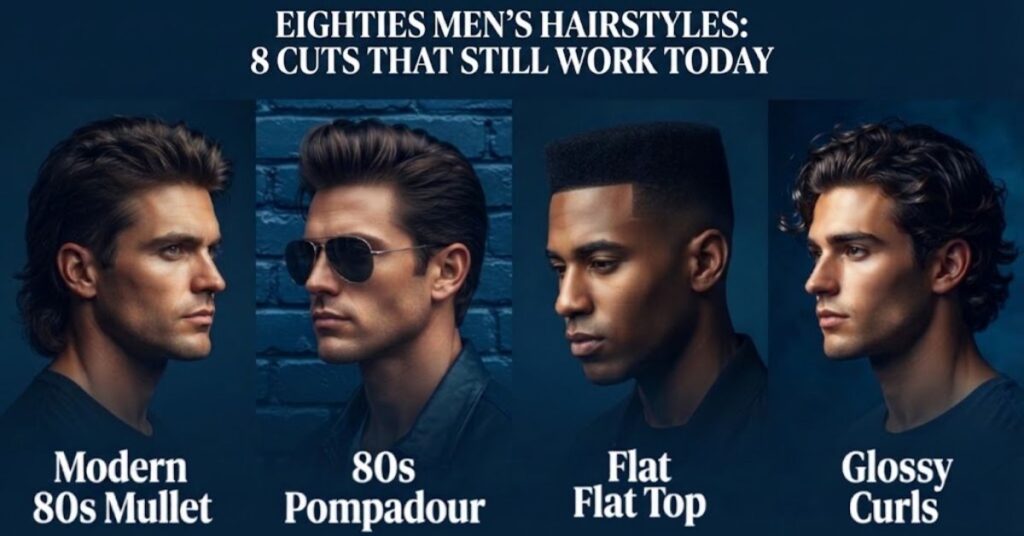
The mullet is the most recognizable of all 80s men’s hairstyles. It is short on the top and sides and longer at the back. The original version was often shaggy and uneven. The modern one is tidier.
Why it works today: a tapered fade on the sides keeps the shape sharp, while the back is trimmed to a clean, textured length.
Best for: wavy or straight hair, oval and square faces.
Styling tip: apply sea salt spray to damp hair, then rough-dry with your fingers.
Try on Modern 80s Mullet
Upload your photo and preview how much back length suits your jawline before you commit.
2. Textured 80s Pompadour
The pompadour lifts the front of the hair up and back. Eighties versions were stiff and glossy. Today’s textured pompadour looks softer and more natural.
What to ask for: longer hair on top, a low or mid taper on the sides, and light layering for movement.
Best for: oval, oblong and heart-shaped faces. The added height balances a wider jaw.
Styling tip: blow-dry the front upward with a round brush, then finish with matte clay.
Try on 80s Pompadour
Preview different heights. A little extra lift can change how long your face looks.
3. Flat Top
The flat top is a short, upright cut with a level surface on the crown. It has roots in military and athletic grooming and became a fixture of 80s pop culture.
Why it works today: it is structured, low on product and easy to read as intentional.
Best for: straight or thick hair, round and oval faces. It adds angles and height.
Maintenance: expect a trim every two to three weeks to keep the top flat and the lines crisp.
Try on Flat Top
Check how the squared shape sits against your face before you ask for the clippers.
4. Feathered Layers
Feathered layers are soft, face-framing sections that sweep back from the forehead. The look was common in the late 70s and carried well into the 80s.
Why it works today: it fits medium-length hair and needs very little styling.
Best for: straight or slightly wavy hair, and men who want length without bulk.
Styling tip: blow-dry the sides back with a medium brush and set with a light-hold cream.
Try on Feathered Layers
See how the layers fall around your cheekbones and forehead.
5. Glossy Curls
The curl-forward styles of the decade, including the wet-look curl, have returned in a healthier form. The shine now comes from moisture and light oils instead of heavy gel.
What to ask for: a rounded shape, even length on top and a soft taper at the sides.
Best for: naturally curly, wavy and loosely coily hair.
Styling tip: apply a leave-in conditioner and a curl cream to wet hair, then diffuse or air-dry.
Try on Glossy Curls
Preview the curl size and shine level before you book your cut.
6. High-Top Fade
The high-top fade is tall on the crown with tightly faded sides. It became a hallmark of 80s hip-hop and street style.
Why it works today: it is clean, bold and highly customizable. You can add parts, designs or a sharp line-up.
Best for: coily and tightly curled hair, oval and diamond faces.
Maintenance: fades lose their edge fast, so plan on a fresh cut every two to three weeks.
Try on High-Top Fade
Try different fade heights to find the contrast that flatters your face shape.
7. Rocker Curly Shag
This is a layered, shoulder-grazing cut with loose waves or curls. It echoes the hard rock and glam metal scene of the decade.
Why it works today: layering removes weight and gives curls a clear shape.
Best for: medium to thick wavy or curly hair.
Styling tip: scrunch in a curl cream, let it air-dry, and avoid brushing once dry to prevent frizz.
Try on Rocker Curly Shag
Preview the length. A few inches can move the cut from tidy to full rocker.
8. New Wave Bowl Cut
The new wave bowl cut is a blunt, even fringe with short sides and a rounded top. It came from the new wave and post-punk scene. The modern version uses texture and a lightly tapered nape.
Best for: straight to wavy hair, oval and long faces. A heavy fringe shortens a long forehead.
What to avoid: a perfectly uniform bowl. Ask for a textured, point-cut fringe so it looks current.
Try on New Wave Bowl Cut
Check fringe length on your photo, since a half inch makes a visible difference.
Face Shape Guide
Use this quick guide as a starting point.
- Oval: most 80s men’s hairstyles work. Try the pompadour or mullet.
- Round: add height and angles with a flat top or high-top fade.
- Square: soften the jaw with feathered layers or glossy curls.
- Oblong: avoid too much height. A bowl cut or layered shag adds width.
- Heart: keep the sides fuller. A textured pompadour or shag balances the chin.
- Diamond: pick a style with fullness at the forehead, such as a fringe or pompadour.
Hair Texture and Maintenance
Texture matters more than most people expect. A style that looks great on thick straight hair can fall flat on fine hair.
| Hair type | Best cuts | Salon visit |
|---|---|---|
| Fine or thin | Flat top, textured pompadour, feathered layers | Every 3 to 4 weeks |
| Thick straight | Flat top, bowl cut, pompadour | Every 3 to 5 weeks |
| Wavy | Mullet, shag, feathered layers | Every 4 to 6 weeks |
| Curly | Glossy curls, curly shag | Every 6 to 8 weeks |
| Coily | High-top fade, glossy curls | Every 2 to 4 weeks for fades |
These timings are general estimates. Your barber can adjust them based on how fast your hair grows.
What to Tell Your Barber
A clear request prevents most bad haircuts. Use this checklist.
- Show two or three photos, including a front view and a side view.
- Name the length on top in inches or centimeters.
- State the fade type: low, mid, high or none.
- Describe the finish: matte, natural or glossy.
- Mention how long you will spend styling each day.
- Ask what products and tools the cut will need at home.
A good barber will tell you if a style needs a different texture or length than you expect. Listen to that advice.
How to Preview the Cut in HairWow
Previewing takes only a few minutes.
- Choose a clear, well-lit photo facing the camera. Pull hair back from your face.
- Upload it to HairWow.
- Select a style, such as the modern mullet, flat top or pompadour.
- Compare two or three versions side by side.
- Save your favorite and show it to your barber.
Treat the result as a guide, not a guarantee. Real hair density, growth patterns and cowlicks will change the final look.
Styling Without Damaging the Hair
The 80s were known for heavy gel, hairspray and hot tools. You do not need all of that.
- Wash two to four times a week, depending on your scalp and texture.
- Use heat protectant before blow-drying or using a flat iron.
- Choose water-based or matte products that rinse out easily.
- Remove product fully at night so it does not build up on the scalp.
- Trim split ends regularly, especially on longer cuts.
- Do not sleep in stiff gel or hairspray.
The American Academy of Dermatology recommends gentle handling and limiting heat and tight styling to protect hair. If you notice thinning, itching or flaking, speak with a dermatologist.
Common Mistakes
- Copying the original too closely. A full 1985 look can feel like a costume. Keep one retro feature and modernize the rest.
- Ignoring face shape. Height and fringe change proportions fast.
- Using too much product. A pea-sized amount of clay or cream is often enough.
- Skipping trims. Fades, flat tops and bowl cuts depend on sharp lines.
- Not matching texture. Straight-hair styles on curly hair, or the other way round, need extra work.
- Booking without a preview. A quick virtual try-on can catch problems early.
Eighties Men’s Hairstyles FAQ
What was the most popular 80s men’s hairstyle?
The mullet is usually named the most iconic, with feathered layers, perms and the pompadour close behind.
Are 80s mullets back?
Yes. Modern mullets use tapered sides and textured backs, so they look cleaner than the originals.
Which 80s hairstyle is easiest to maintain?
Feathered layers and the textured pompadour are the easiest, since they need little product and fewer trims.
What 80s hairstyle works for thin hair?
A short flat top, textured pompadour or layered feathered cut adds the look of fullness.
What 80s hairstyle works for curly hair?
Glossy curls, the rocker curly shag and the high-top fade all work well on curly and coily hair.
Can I wear an 80s hairstyle without looking dated?
Yes. Choose a cleaner fade, softer texture and less product, and keep the rest of your outfit current.
Conclusion
Eighties men’s hairstyles last because they have a clear shape and a strong point of view. The modern mullet, textured pompadour, flat top, feathered layers, glossy curls, high-top fade, rocker curly shag and new wave bowl cut all work today when they are adapted to your face and hair.
Pick the cut that fits your texture and routine, preview it on your own photo, and bring clear references to your barber. Keep the retro idea, but let the finish be modern.

