

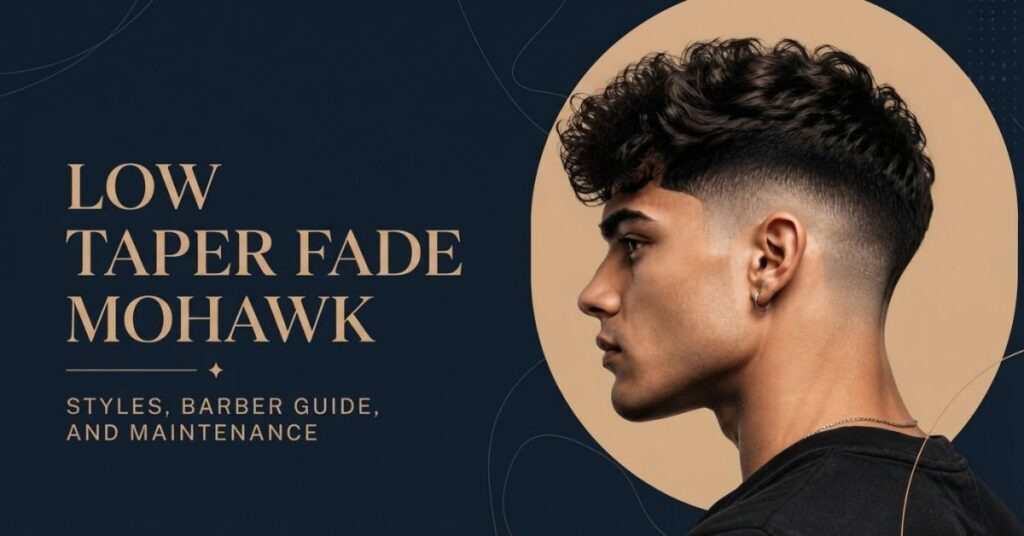
A low taper fade mohawk keeps a longer strip of hair down the center and blends the sides short only near the ears, sideburns, and neckline. It looks bolder than a crop and calmer than a high skin fade. That balance is why it works for offices, classrooms, and weekends alike.
The name covers many versions, though. Strip width, top length, hair texture, and how short the edges go all change the result. This guide shows you how to tell them apart, brief your barber, style the top, and keep the cut fresh.
Quick answer
- A low taper fade mohawk is a longer center strip over sides that taper low, near the natural hairline.
- Four choices define it: fade path, shortest endpoint, strip width, and top length.
- It suits straight, wavy, curly, and coily hair when the cut matches your texture.
- The fade needs attention sooner than the top, so plan two maintenance tracks.
What is a low taper fade mohawk?

A low taper fade mohawk combines two jobs. One is a strip of longer hair running from the front hairline toward the crown. The other is a short, gradual blend that stays low around the ears and neckline.
The result is contrast without drama. More hair stays on the sides than in a mid or high fade, so the strip stands out but the whole head still looks balanced.
Barbers use “taper” and “fade” loosely, and the meaning shifts from shop to shop. A photo and a clear description of the finish work better than the label alone.
Where does the low taper sit?
The shortest hair sits near the sideburns, behind the ears, and along the nape. Above that, the length builds back up gently toward the sides of the head.
Two details are worth stating separately:
- Start point: how high the blend climbs above the ear.
- Endpoint: whether the shortest area stays as soft stubble or goes to bare skin.
A taper usually leaves a soft finish. A skin fade finishes with a foil shaver. Naming the endpoint on its own avoids the most common mismatch.
What makes the center section a mohawk?
The strip does. Without a clearly longer section down the middle, you have a fade, not a mohawk.
The strip can be narrow and sharp or wide and relaxed. It can be cropped and textured, or long enough to stand upright. Some versions stop at the crown, while others run into the nape for a mullet-style back.
How it differs from a burst fade, skin fade, and faux hawk

These names describe different variables, which is why people mix them up. “Low” describes height. “Burst” describes a curve around the ear. “Skin” describes the endpoint. “Faux” describes how the ridge is made.
| Cut | Blend location | Ridge made by | Contrast |
|---|---|---|---|
| Low taper fade mohawk | Ears, sideburns, neckline | Cutting | Low to medium |
| Burst fade mohawk | Curves around the ear | Cutting | Medium |
| Low skin fade mohawk | Low, down to bare skin | Cutting | High |
| Faux hawk fade | Varies | Styling | Low to medium |
The contrast column is a consultation guide, not a measurement.
Low taper mohawk vs burst fade mohawk
A low taper keeps its blend close to the sideburns and neckline. A burst fade curves around the ear and often leaves more length behind that curve, so the back of the head looks fuller.
You can combine them. If you want the curve, bring a photo that shows the back of the head clearly, because front-only photos hide the part the barber needs most. A drop fade is a third option that arcs down behind the ear toward the nape.
Mohawk fade vs faux hawk fade
A mohawk fade is cut into the head. The sides are clipped short and the strip stays until it grows out.
A faux hawk keeps more side length and uses product to push the hair toward the center. Skip the styling and the sides fall back down. That makes the faux hawk easier to back out of, and the cut mohawk more reliable on busy mornings.
Low taper vs low skin fade on a mohawk
Both start low. The taper blends softly and never needs to touch bare scalp. The skin fade goes to skin and looks crisper on day one.
That crispness fades quickly. Regrowth shows sooner on a skin finish, and bare scalp is more exposed to close clipping. If you want fewer barber visits or you react to close shaving, the taper is the forgiving choice.
Is a low taper fade mohawk right for you?
Fit depends less on face-shape charts and more on texture, density, growth patterns, and how much upkeep you will actually do. A consultation matters more here than it does for a buzz cut.
Does it work with straight, wavy, curly, and coily hair?
Yes, with different tactics for each.
- Straight: needs direction and hold. Unstyled, the strip can lie flat.
- Wavy: natural movement fills out the strip, so lighter product usually works.
- Curly: the curl pattern can form the ridge itself. Shrinkage makes hair look shorter than it is.
- Coily: the strip becomes a full frohawk. Moisture and gentle picking matter more than heavy clipping.
Match the photo you bring to your own texture. A straight-hair reference on coily hair shows your barber a different job.
Which face and head shapes suit it?
Face-shape rules for this cut are convention, not hard evidence. Treat them as starting points.
The more useful link is between strip width and head size. A very narrow strip on a wide head can look thin. A very wide strip on a smaller head can swallow the contrast. Height lengthens the face visually, while a wider strip and softer edges keep it calm.
Agree the width before clipping starts. Barbers often measure it in fingers.
How much hair and density do you need?
About two inches on top is a realistic minimum for a strip you can lift and direct. Three to four inches gives more styling options. Curly and wavy textures tend to look fullest a little longer.
Fine or thinning hair is not a deal breaker. A narrower, shorter strip avoids drawing attention to scalp, and a volumizing pre-styler adds body. Ask the barber to check your crown and hairline growth direction. A strong cowlick can fight the shape you want.
Is it practical for work, school, and daily styling?
Often, yes. Contrast is the dial. A moderate strip over a soft low taper tends to read as neat and intentional. A skin finish with a very wide or tall strip reads bolder.
Dress codes vary, so check yours instead of assuming. A short, textured version is the easiest option for strict settings.
Low taper fade mohawk styles to show your barber

Four structural variations cover most of what people want. Each changes the strip, the edges, or the back, and each has its own upkeep cost.
Classic textured low taper mohawk
This is the safest entry point. It has a medium-width strip, visible texture, and enough side length to soften the contrast.
Ask for point cutting on top. It breaks up the ends so the strip looks separated instead of blocky. A matte clay or fiber suits it, because shine tends to look dated on a textured finish. If this is your first mohawk, you can always go narrower or tighter next time.
Curly or coily low taper frohawk
Here the texture does most of the work. The edges stay low and the top keeps enough length for curls or coils to form the ridge.
Curl cream or leave-in conditioner shapes it without weight. Heavy waxes and stiff clays often fight the pattern. This version usually needs less daily effort than a straight-hair strip because height comes built in.
Short, subtle low taper mohawk
Crop the top close and the mohawk turns into something like a textured crop with a defined center. Edges stay soft and contrast stays low.
Daily styling drops to almost nothing, and growing out is easier because there is less height to lose. Choose this if you want the silhouette without the morning routine.
Mohawk mullet, V-neck, and design variations
“Mohawk mullet” bundles three separate requests, and your barber needs each one clearly:
- Nape length: the strip continues into the back instead of ending at the crown.
- Neckline shape: V-shaped, rounded, or squared.
- Design work: a hard part or shaved line in the faded sides.
Shaved lines soften as hair grows, so refresh them at each visit. Simple bold lines hold up longer than intricate patterns.
What should you ask your barber for?
Naming the haircut is not enough. Give your barber four decisions:
- Fade path: low edges, curved burst, or drop.
- Endpoint: soft taper, very short clipper guard, or skin.
- Strip width: narrow, medium, or wide.
- Top and back length: short ridge, medium textured strip, long frohawk, or mullet back.
Use a barber script and reference photographs
Bring two or three photos that show the front, side, and back. Pick images with hair like yours in texture and density.
Then say it in one sentence:
“I’d like a medium-width mohawk strip from the front to the crown, a low taper around my ears and neckline that doesn’t reach skin, and about three inches on top, point cut for texture.”
Ask whether the plan fits your hair today or needs a few weeks of growth. A good barber adjusts the width and curve to your head instead of copying a photo exactly.
Confirm the neckline, line-up, beard blend, and finish
Settle four quick details before clippers touch your hairline:
- Neckline: natural, tapered, rounded, or squared. A tapered neckline often suits a mohawk better than a hard square.
- Line-up: crisp edge or softer natural hairline.
- Beard blend: whether sideburns blend into facial hair at the same visit.
- Finish: matte and textured, or defined and separated.
Each is a yes or no. Asking now saves a second appointment.
How do you style a low taper fade mohawk?
Direction matters more than product strength. Shape the strip inward and up while the hair is damp, then lock it in once dry. Straight and wavy hair need more help holding the shape. Curls and coils often hold it on their own.
How to style straight or wavy hair
- Pat the hair dry with a towel instead of rubbing.
- Apply a light pre-styler while damp.
- Guide the sides toward the center with a comb or fingers.
- Blow dry on low or medium heat, lifting at the roots.
- Once dry, work a small amount of matte clay or fiber through the strip and separate the sections.
How to style curly or coily hair
- Apply curl cream or leave-in conditioner to damp hair.
- Use your fingers, not a brush, to guide curls toward the center.
- Air dry, or use a diffuser on the lowest heat.
- Between washes, refresh with a light water mist and a little product instead of rebuilding.
Which product type should you use?
| Texture | Product that works | Avoid |
|---|---|---|
| Straight | Matte clay or fiber | High-shine pomade |
| Wavy | Sea salt spray, then light matte cream | Heavy product that flattens waves |
| Curly | Curl cream or hydrating styler | Heavy clay |
| Coily | Butter or curl cream | Stiff, waxy formulas |
Formulas vary, so follow the label on your product.
How do you maintain the cut and protect your scalp?
The low edges lose definition before the top loses shape. Treat them as two tracks: frequent fade refreshes and less frequent strip trims.
When does the fade need a refresh?
Watch the edges, not the calendar. When the sideburn line, ear outline, or neckline begins to blur, the cut looks unkempt even if the top still looks good.
Barbers give different ranges. A common guide is one to two weeks for skin fades, two to three for low and mid fades, and three to four for tapers. Your growth rate and how sharp you like it will move those numbers. A growing-out cowlick is a second sign, because it changes how the strip sits.
How should you wash and condition it?
Wash based on scalp oil and texture, not a fixed schedule. Oily scalps with straight hair often need more frequent washing. Dry, curly, or coily hair usually needs less. Put shampoo on the scalp, not down the length, and condition where hair is driest, mostly the ends.
How can you reduce heat damage, bumps, and irritation?
Heat damages every hair type, so keep the dryer on low or medium and use a heat protectant.
Close clipping can irritate skin. Softening the hair with a warm damp cloth first and cutting with the direction of growth can help. Do not keep going over the same bumpy patch with a trimmer.
If you get painful, persistent, or scarring bumps at the back of the neck, see a board-certified dermatologist. The American Academy of Dermatology notes that bumps in that area can be acne keloidalis nuchae, which can worsen without treatment. In the meantime, ask for a softer endpoint such as a taper.
Common mistakes, grow-out, and lower-commitment alternatives
Mistakes that change the intended silhouette
- Home fade touch-ups. One uneven pass leaves a step that takes weeks to grow out. Tidy only the forehead line.
- Choosing strip width by default. Decide it before clipping, and check it again once the hair is dry.
- Skipping the upkeep talk. You may leave with a cut that needs more visits than you will make.
- Using shiny product on a textured top. It flattens the ridge.
How does it grow out?
Expect an awkward phase for roughly four to eight weeks. The strip grows into the sides and the silhouette blurs.
You have two options. A transitional cut that reshapes the strip and softens the contrast is the usual bridge. A reset to a buzz or crew cut is the fastest exit. Pick the end result first, then have your barber reshape toward it over a few visits.
What should you choose for less commitment?
| If your concern is | Consider |
|---|---|
| Daily styling time | A short, textured version or a textured crop |
| Committing to the cut | A faux hawk fade |
| Frequent visits | A taper endpoint instead of skin |
| The grow-out stage | A textured crop or undercut quiff as a bridge |
On cost, prices vary by city and shop, and more detail usually means more chair time. Ask for a quote that covers the fade, strip shaping, line-up, and any design work.
Frequently asked questions
How long does the hair on top need to be?
About two inches is a workable minimum, and three to four inches gives more styling options.
Can you wear it without styling it up every day?
Yes. A short, textured strip or curly hair that holds its own shape needs little daily effort.
Does it work with a receding hairline or thin crown?
Yes. A narrower, shorter strip and a soft low taper avoid highlighting thin areas.
How often does a low taper fade mohawk need a touch-up?
Most people refresh the edges every two to four weeks, sooner for skin finishes.
How long does it take to grow out?
Plan for about four to eight weeks of an in-between stage before it settles.
Can you keep the fade sharp with home touch-ups?
Only the forehead line. Fade work at home often leaves steps that take weeks to fix.
What should you do if close clipping causes bumps?
Soften the hair first, cut with the grain, and ask for a taper instead of skin. See a dermatologist if bumps persist or scar.
Is a low taper fade mohawk good for curly or coily hair?
Yes. Curls and coils often build the ridge themselves, so the cut can look full with less styling.
Before you book
A low taper fade mohawk works because each part adjusts on its own. Fade path, endpoint, strip width, and top length are four separate dials, and each one changes how loud the cut looks.
Decide on all four before you sit down. Bring photos from the front, side, and back that match your texture, and ask about upkeep before the first clipper pass. That conversation is usually the difference between the cut you pictured and the one you get.

