

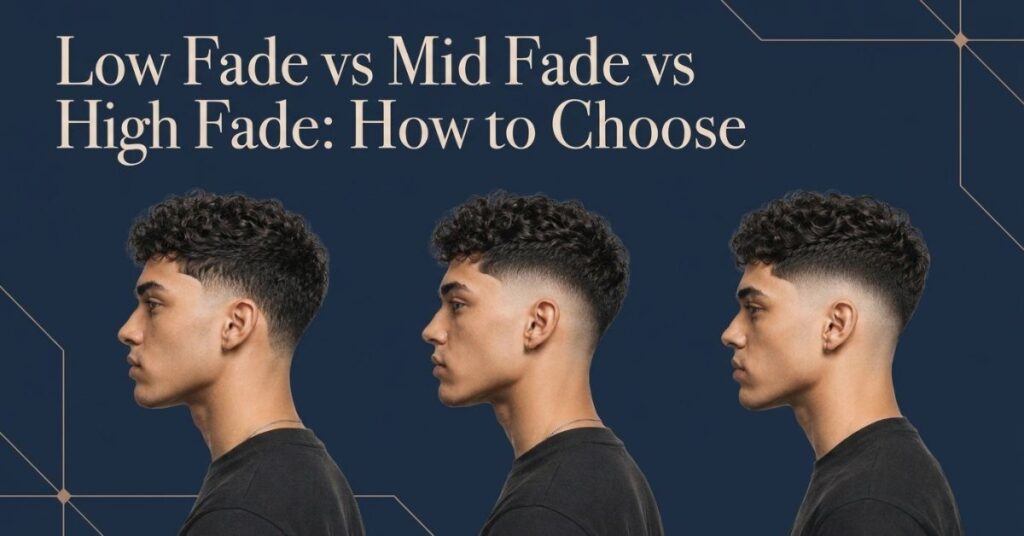
Choosing between a Low Fade vs Mid Fade vs High Fade can be confusing because the differences may look small in photos. However, fade height can change your face shape, side profile, hair volume, maintenance needs, and overall appearance.
A low fade creates a clean but natural look. A mid fade gives you a balanced mix of contrast and versatility. A high fade delivers the strongest contrast and a sharper, more dramatic finish.
The right choice depends on your face shape, hair texture, hair density, top length, beard, lifestyle, workplace, and personal style.
Key takeaways
- A low fade is ideal for a subtle, professional appearance.
- A mid fade offers a balanced option for most everyday hairstyles.
- A high fade creates the strongest contrast and tightest sides.
- Long faces often suit low or low-mid fades because they retain more side width.
- Round faces can benefit from mid fades with controlled height on top.
- Curly and coily hair needs careful planning because fade height affects the overall shape.
- Beard wearers should plan the fade and beard connection together.
- Your face shape and hair texture matter more than simply copying a haircut photo.
- If you are unsure, starting with a lower fade gives you more flexibility.
Definition: A fade is a haircut where the hair gradually becomes shorter toward the sides and neckline. Low, mid, and high describe where that transition begins.
Quick comparison
Low, mid, and high fades do more than change clipper placement. They create different silhouettes by controlling how much hair remains on the sides.
| Fade type | Where it starts | Best for | Overall look | Maintenance |
|---|---|---|---|---|
| Low fade | Lower ear and neckline area | Professional styles, beginners, fuller sides | Clean and subtle | Every 2–4 weeks |
| Mid fade | Middle side or temple area | Modern, versatile hairstyles | Balanced and noticeable | Every 2–3 weeks |
| High fade | Above the temple | Short, bold hairstyles | Sharp and dramatic | Every 1–2 weeks |
Use this simple rule:
- “Clean but natural” → Low fade
- “Modern but versatile” → Mid fade
- “Sharp and bold” → High fade
The biggest mistake is choosing a fade only because it looks good on someone else. A high fade can look excellent on one person but make another person’s face appear longer or narrower.
A low fade can look polished on thick hair, but it may feel too subtle if you want a dramatic change.
What is a low fade?

A low fade starts close to the lower part of the head, usually around the ears, sideburns, and neckline. More hair remains on the upper sides, creating a fuller and softer shape.
Choose a low fade if:
- You are getting your first fade.
- You need a school or workplace-friendly style.
- You want cleaner sides without removing too much volume.
- You have a long or narrow face.
- You want more width around the sides.
- You have curls, coils, waves, or twists.
- You prefer easier grow-out.
A low fade works well with textured crops, side parts, short waves, curly tops, Ivy League cuts, and longer scissor-cut styles.
You can also choose how short the bottom should be. A number 1 or 2 creates a softer result, while taking the lowest section down to skin creates more contrast.
The main drawback is that a low fade can feel conservative. If you want a very noticeable transformation, a mid or high fade may suit you better.
What is a mid fade?

A mid fade begins around the middle portion of the side of the head, commonly near the temple area. It removes more side weight than a low fade without climbing as high as a high fade.
For many men, it is the most balanced fade height.
Choose a mid fade if:
- You want a modern everyday haircut.
- You want your top texture to stand out.
- You have a round, oval, or square face.
- You like crops, quiffs, Caesar cuts, crew cuts, or comb overs.
- You want visible contrast without extremely short sides.
- You want a style that remains attractive as it grows.
A mid fade works with straight, wavy, curly, and coily hair. It provides enough contrast to look modern while leaving enough hair above the fade for a natural connection.
One issue is that barbers may interpret “mid fade” differently. One may keep the blend relatively low, while another may take it higher.
For better results, show a clear side-view reference and explain where you want the blend to sit.
What is a high fade?

A high fade starts above the temple and removes a large amount of hair from the sides. The transition climbs higher toward the upper sides, creating a stronger difference between the top and sides.
This gives the haircut a sharper and more dramatic silhouette.
Choose a high fade if:
- You want strong contrast.
- You prefer very short sides.
- You like buzz cuts, crops, high-and-tight styles, or hard parts.
- Your hair creates excessive side bulk.
- You want your top texture to stand out.
- You are comfortable with frequent touch-ups.
A high fade works particularly well with textured crops, messy tops, buzz cuts, short curls, and other short hairstyles.
It can also help control hair that grows outward and makes the sides appear wider.
However, a high fade requires more commitment. It grows out more noticeably and may make a long face appear even longer.
It can also reveal uneven temples, hairlines, or scalp density more clearly than a low fade.
Which fade should you choose: Low Fade vs Mid Fade vs High Fade?
The best fade depends on what you want from your haircut.
| Your goal | Best fade | Why |
|---|---|---|
| Cleaner version of your current haircut | Low fade | Keeps the natural silhouette |
| Modern everyday style | Mid fade | Adds balanced contrast |
| Very tight sides | High fade | Removes the most side bulk |
| Conservative work haircut | Low or soft mid fade | Looks polished without being extreme |
| Reduce wide side volume | Mid or high fade | Controls the sides |
| Balance a long face | Low or low-mid fade | Retains more side width |
| Round face | Mid fade | Tightens the sides without going too extreme |
| Curly or coily hair | Low, drop, or temple fade | Preserves more shape |
| Beard connection | Low or mid fade | Leaves room for a smoother blend |
If you are unsure, start lower.
A barber can usually raise a low fade during the appointment. Once a high fade has been cut, however, the removed hair cannot be brought back immediately.
Face shape guide

Fade height changes the outline of your face. The same haircut can make one person look sharper while making another appear too narrow or long.
Round face
A round face often works well with a mid fade and moderate volume on top. Tightening the sides creates a cleaner outline.
Some height or texture on top can add definition without making the haircut look exaggerated.
A mid fade is usually enough. You do not automatically need an extremely high fade.
Good options: mid fade, low-mid fade, textured crop, quiff, and short curls with a drop fade.
Square face
Square faces already have strong structure around the jaw and forehead. This makes them flexible when choosing fade height.
A mid fade is a reliable choice. A high fade can create a sharper appearance when the top remains controlled.
A low fade is ideal when you prefer a classic or professional finish.
Good options: mid fade, hard part fade, Ivy League fade, low fade with side part, and buzz cut fade.
Oval face
Oval faces can usually handle almost any fade height.
Your decision can focus more on hair texture, maintenance, and personal style.
Choose a low fade for a softer appearance, a mid fade for versatility, or a high fade when you want stronger contrast.
Good options: low fade, mid fade, high fade, crop fade, comb-over fade, and curly fade.
Long face
Long faces should be more careful with extremely high fades and very tall hairstyles.
Removing too much side width can make the face appear longer. A low or low-mid fade usually provides better balance.
Keep the top controlled instead of adding excessive vertical height.
Good options: low fade, low-mid fade, low taper, softer side part, and textured crop.
Heart or triangle face
Heart and triangle face shapes can have more width around the forehead and a narrower jaw.
Taking the temples too tight may exaggerate that difference. A low or mid fade can create a more balanced outline.
Textured fringes can also add useful width and movement around the upper face.
Good options: low fade, mid fade with fringe, textured crop, soft side part, and low taper.
Hair type guide
Your hair texture can change how a fade looks after washing, styling, and several days of growth.
| Hair type | Good fade choice | Watch out for |
|---|---|---|
| Straight | Low fade, mid fade, hard part fade | Very high fades can look severe |
| Wavy | Mid fade, low fade, textured crop | Too much product can weigh down the top |
| Curly | Low fade, drop fade, mid fade | Shrinkage changes the visible length |
| Coily | Temple fade, low fade, drop fade | A high fade can remove useful side support |
| Fine | Low fade, soft mid fade | Very short fades can expose more scalp |
| Thick | Mid fade, high fade | The top still needs proper blending |
With curly and coily hair, plan the top shape before choosing the fade height.
Think about whether you want curls, coils, waves, twists, or an afro shape. Then choose a fade that supports that style.
Fine hair needs a slightly different approach. A skin fade can expose more scalp than expected. A softer low fade may create a more even appearance.
Taper vs fade: where the confusion starts
Many people use “taper” and “fade” as if they mean the same thing. They do not.
A taper mainly cleans the sideburns, area around the ears, and neckline while keeping most of the side shape.
A fade removes more hair from the sides and creates a stronger gradient.
The simple difference is:
- Taper: cleaner edges with more side length.
- Low fade: subtle visible transition.
- Mid fade: clear modern contrast.
- High fade: very tight sides and strong contrast.
This difference matters because hairstyle names are sometimes used loosely.
One barber may interpret “low taper fade” as a traditional taper. Another may create a noticeable low fade.
Use both words and pictures when explaining your desired style. Most importantly, tell your barber how high you want the blend.
What to tell your barber
Do not simply say, “Give me a fade.”
Tell your barber the fade height, shortest guard, top length, neckline, sideburn treatment, and desired finish.
Low fade barber script
“I want a low fade. Keep it low around the ears and neckline. Do not take the blend too high. Leave enough weight above the fade so the haircut keeps a natural shape.”
If you do not want exposed skin, add:
“Keep the shortest part around a number 1 or 1.5. I do not want a skin fade.”
Mid fade barber script
“I want a mid fade around the temple area, but I do not want it to become a high fade. Keep the blend clean and leave enough length on top for texture.”
High fade barber script
“I want a high fade with tight sides and strong contrast. Keep the top shape controlled and make sure the transition is smooth.”
Beard blend script
“Blend the sideburn into the beard so the haircut and beard look connected. Keep the beard lines clean without making the sideburn look disconnected.”
Maintenance and grow-out
Fade maintenance depends on how short the sides are and how sharp you want the haircut to remain.
| Fade | Looks sharp for | Typical refresh | Grow-out |
|---|---|---|---|
| Low fade | 1–2 weeks | 2–4 weeks | Softer and easier |
| Mid fade | 1–2 weeks | 2–3 weeks | Noticeable but manageable |
| High fade | 5–10 days | 1–2 weeks | More obvious |
If you have a wedding, interview, photo shoot, or important event, schedule your haircut around one to three days beforehand.
This gives the haircut time to settle while keeping the fade fresh.
At home, keep your styling routine simple. Choose a product based on your hair type and the shape you want.
A low fade may only need light cream or leave-in conditioner. A mid fade can benefit from paste or styling cream when you want more definition.
A high fade puts more attention on the top, so keep the styling controlled and intentional.
Skin and shaving cautions
A skin fade or extremely tight fade can irritate sensitive skin around the scalp, neck, and beard area.
Very close cutting can also increase the chance of razor bumps and ingrown hairs, especially with tightly curled hair.
If you often experience irritation, ask your barber to leave the shortest section slightly longer.
Useful rules include:
- Avoid a skin fade when your skin is already irritated.
- Tell your barber if you regularly get razor bumps.
- Avoid harsh products on freshly shaved areas.
- Keep hats, helmets, and collars clean after a fresh fade.
- Seek professional medical advice for painful or persistent bumps.
The closer the fade gets to the skin, the more important proper aftercare becomes.
How to preview the fade before you cut
Fade regret often happens because people judge a haircut from somebody else’s head.
A model photo cannot show exactly how the fade will work with your own hairline, face width, hair density, or head shape.
Before your appointment:
- Take a clear front-facing photo.
- Consider how a low fade would frame your face.
- Compare it with a mid fade.
- Consider a high fade only if you want stronger contrast.
- Save a clear reference photo for your barber.
The goal is not to copy another person’s haircut perfectly.
Use the reference to communicate the fade height, top length, texture, and overall finish.
Common mistakes
Mistake 1: Asking for a high fade when you wanted a mid fade
Some high fades can look like mid fades in cropped photos.
Always show your barber a clear side-view reference when possible.
Mistake 2: Ignoring the top length
Fade height and top length work together.
A high fade with a tall top can create a dramatic silhouette. A low fade with an excessively heavy top may look unfinished.
Decide how both sections should work together before the haircut begins.
Mistake 3: Choosing a skin fade by default
A skin fade looks clean, but it is not automatically the best option.
If you prefer easier grow-out or have sensitive skin, a number 1 or 1.5 may give you a better result.
Mistake 4: Not planning the beard
A beard can make a fade look much sharper when the transition is planned correctly.
Ask your barber to connect the haircut and beard instead of treating them as completely separate areas.
Mistake 5: Using the wrong reference photo
A reference model may have completely different hair density, texture, hairline, or head shape.
Use the photo to communicate the style direction. Then let your barber adapt it to your features.
FAQ
Which is better, low fade or mid fade?
A low fade is better if you want a subtle, professional haircut with easier grow-out.
A mid fade is better if you want more visible contrast while keeping the haircut versatile.
If you cannot decide, start with a low fade. You can always go higher during a future appointment.
Is a high fade too aggressive?
A high fade is not automatically too aggressive, but it creates the strongest contrast of the three.
It removes more hair from the sides and makes growth more noticeable. It works best when you want a sharp haircut and do not mind regular touch-ups.
What fade is best for a round face?
A mid fade is usually a strong choice for a round face.
It tightens the sides while leaving enough structure to balance the top. Moderate texture or height can add definition.
What fade is best for a long face?
A low fade or low-mid fade is usually safer for a long face.
These styles retain more visual width around the sides and reduce the chance of making the face appear longer.
What should I ask for if I do not want skin showing?
Ask for a low or mid fade without taking the shortest section down to skin.
You can say, “Keep the shortest part around a number 1 or 1.5. I do not want a skin fade.”
How often should I get a fade touched up?
Low fades usually need a refresh every 2–4 weeks.
Mid fades typically need maintenance every 2–3 weeks.
High fades often look their sharpest with a refresh every 1–2 weeks.
Is a taper the same as a low fade?
No.
A taper mainly cleans the sideburns, area around the ears, and neckline. A low fade creates a more visible gradient on the lower sides.
They can look similar, so tell your barber exactly how high you want the blend.
Can curly hair get a high fade?
Yes. Curly hair can work very well with a high fade.
However, a high fade removes more side support, which can make the curls look more prominent. If you want softer growth, consider a low, drop, or temple fade.
Summary
Choose a low fade if you want a cleaner, softer haircut that grows out naturally.
Choose a mid fade if you want a balanced option for everyday wear.
Choose a high fade if you want strong contrast, tight sides, and a sharper appearance.
The fade name is only one part of the decision. Your fade placement, shortest guard, top length, hair texture, beard connection, face shape, and maintenance routine all matter.
When you are unsure, start with a lower fade. It gives you more flexibility and allows you to increase the contrast at a future appointment.

