

A low taper fade blonde hair on blonde hair gives you a clean, understated cut with a lot of room to play on top. The fade stays near your sideburns and neckline, so the blonde section keeps its length, texture and color. This guide covers the best styles, how to explain the cut to your barber, and how to keep both the fade and the blonde looking fresh.
Quick answer: A low taper fade blonde cut shortens the sides gradually from the sideburns and nape. The top stays longer and can be natural, highlighted or bleached. It suits straight, wavy, curly and coily hair.
What is a low taper fade on blonde hair?

A low taper fade on blonde hair is a haircut where the sides and back get shorter in smooth steps, starting low around the sideburns and neckline. The blonde top is left longer. The color is a separate choice from the cut, so it can be natural, highlighted or fully lightened.
Barbers usually build the fade with clipper guards. They start with the shortest length at the nape, then step up to longer guards as they move higher. A typical progression might run from a #1 or #2 at the bottom to a #3 or #4 near the temples. Then they blend the lines so no edge shows. The result looks soft and tidy, not harsh.
Because the fade stays low, most of the sides keep their length. That makes it a safe pick if you want a neat look without a dramatic change.
Low taper fade vs low fade vs skin fade

These terms overlap, and barbers do not always use them the same way. Here is the simplest way to think about them:
| Term | What it describes | Typical look |
|---|---|---|
| Low taper | A narrow shortened area at the sideburns and nape | Subtle, natural |
| Low fade | Same low start, but wider coverage around the head | Moderate contrast |
| Skin fade | How short the finish gets (down to bare skin) | Sharp, high contrast |
A skin fade describes the finish, not the height. So you can have a low taper with a skin finish or a low fade with a shadow finish. Always show a photo alongside the name.
Why does blonde hair change the look of the fade?
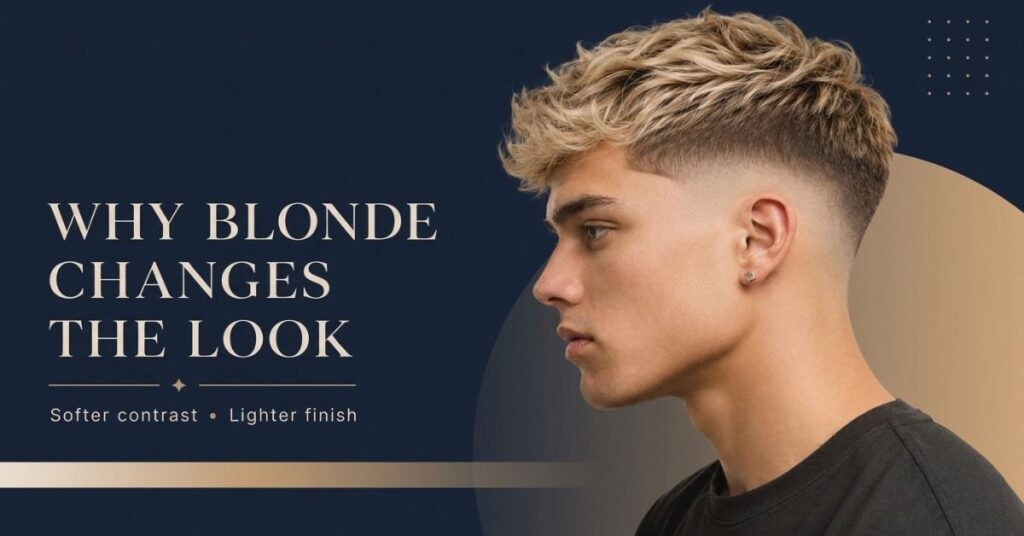
Blonde hair changes how visible the fade looks because light strands create less contrast against skin than dark strands do. The cut itself stays the same, but the blend can look softer or less defined.
Here is what affects the final look:
- Hair tone: Platinum and very light blonde fade into the skin more gently.
- Root depth: Darker roots add contrast above the fade and make it stand out.
- Density: Fine or thin hair shows more scalp, so the fade looks softer.
- Finish: A shadow finish often looks cleaner on lighter hair than bare skin.
Tell your barber your blonde shade and density before the first pass. It helps them choose the right guard and finish.
Does a low taper fade suit your hair?
Most people can wear some version of this cut. What changes is the top length, the products you use and how much daily styling you want. A soft shadow taper is a good starting point if you are new to fades or new to bleaching. It also works well in offices with a conservative dress code.
Which hair textures work best?
All four main textures work. Each one just needs a different approach.
- Straight hair: The shape of the fringe or crop does most of the work. Cutting angle matters more than product.
- Wavy hair: Natural movement looks great with a slightly longer top and light styling.
- Curly hair: Curls shrink when dry, so ask your barber to judge length on dry hair.
- Coily hair: Edge definition and moisture matter most, since dryness shows quickly on a short, faded perimeter.
Fine hair usually looks best with less bulk on top. Thick or coarse hair can carry more volume and longer styles.
What about face shape, density, and hairline?
None of these rule out the cut. They simply guide the details.
- Round face: Keep some height on top to add length.
- Long face: Choose a fringe or a flatter top to avoid adding more height.
- Receding temples: Keep a little extra length at the sides to soften the area.
- Strong crown swirl: Let the barber adjust the blend at the back, since the growth direction affects how the fade lies.
A good barber will tweak guard heights and top length during your consultation. You do not need a different haircut.
10 best low taper fade blonde hair styles
Pick a style based on your hair texture and how much time you want to spend each morning. The list below is grouped by look, with two numbered styles in each group.
Textured fringe and messy crop
This group works well if you want movement at the front and a quiet fade underneath.
- Dirty blonde textured fringe: A warm, slightly darker blonde with choppy layers. A matte clay or paste keeps it looking natural.
- Platinum messy crop: A fully lightened top with a short, piece-y finish. Use a light texture powder so it does not look heavy.
Fine hair does best with a shorter fringe, since long pieces can fall flat without volume.
Curly, wavy, and fluffy top
Here the natural volume does the talking, and the fade frames it.
- Natural blonde curls: Cut the curls to their dry length. Apply a lightweight curl cream to wet hair and let it air dry.
- Fluffy blow-dried top: Works for straight or wavy hair. Use a round brush or diffuser with a light mousse for lift.
You need enough length on top for the curl or wave pattern to show. Too short and it just looks messy.
Short crop, Caesar, and buzz cut
These are the lowest maintenance options. They also show off your head shape and root color more.
- Blonde French crop: A short, textured fringe with tight sides. A small amount of product on damp hair is enough.
- Blonde buzz with low taper: The shortest option. The fade becomes the main detail, so clean blending matters.
A Caesar cut is a close cousin of the French crop. It has an even, short length and a straight fringe, and it needs almost no styling.
Quiff, side part, and slick back
Choose this group for a sharper, more directional finish.
- Textured blonde quiff: Needs enough top length to lift. Blow-dry the hair upward while damp, then finish with matte or medium-hold product.
- Blonde slick back: Uses more product and a comb. It looks polished, but it is harder on fine or damaged hair.
A natural side part works the same way as the quiff. Use a light pomade or cream for control without too much shine.
Blowout, mullet, and longer top
These styles keep the most length, so the taper plays a supporting role.
- Blonde blowout taper: A rounded, voluminous top with a subtle fade at the sides. A round brush and blow dryer are essential.
- Modern blonde mullet: Longer at the back and crown than at the sides. The low taper keeps the sides clean.
These looks need fewer haircuts but more daily styling time.
How do you ask a barber for this haircut?
Give your barber three pieces of information: where the fade starts and how it finishes, how much length to keep on top, and what is happening with your blonde color. Then ask them to repeat the plan back to you before they start cutting.
Try this simple sequence:
- Name your style family, such as textured fringe or blowout taper.
- Show your reference photos.
- Ask for a low placement with a shadow or skin finish.
- Describe the top length and how much bulk to keep.
- Say whether the blonde is done, needs a refresh or is being handled by a colorist.
- Confirm the neckline shape: squared, rounded or tapered.
- Ask them to repeat the plan.
What reference photos should you bring?
Bring three photos: front, side and back. Choose people whose hair texture, density and blonde shade are close to yours. A curly reference will not translate well onto straight hair, no matter how good it looks.
Avoid heavily filtered or AI-generated images. They can show color, density and fade contrast that real hair cannot match. If you are unsure whether a photo is realistic, ask your barber.
What exactly should you say?
Keep it short and specific. Here is a script you can use:
“I’d like a low taper around the sideburns and neckline, finished as a soft shadow. Please keep the length and texture on top. My blonde is already done, so we’re just cutting today.”
Before the clippers come out, ask if your growth pattern or hair condition changes anything about the plan.
How do you style and maintain it?
You are looking after three things on different schedules: the shape of the fade, your daily styling and the condition of the blonde. Treat them separately and upkeep gets much easier.
What is the fastest daily styling routine?
The quickest routine takes five minutes or less:
- Rinse your hair or lightly wet it.
- Towel dry or blow-dry on a low or medium setting.
- Work a small amount of product through damp hair.
- Shape it with your fingers or a comb.
Match the product to your style. Use matte clay for textured crops, a light cream for curls and a pomade for slick backs. Lightened hair is more porous and dries out easily, so use heat protectant and keep tools on a gentler setting. The American Academy of Dermatology recommends low or medium heat and limiting how often hot tools touch your hair.
How often should you refresh the cut and color?
There is no perfect schedule, but these ranges are a helpful starting point:
- Fade and neckline: Many people refresh every 2 to 4 weeks to keep the edges sharp.
- Full haircut with top trim: Every 4 to 8 weeks, depending on the style.
- Color touch-up: Every 4 to 8 weeks, based on root growth and how warm the blonde looks.
Your fade needs attention when the neckline looks fuzzy or the blend has lost its shape. Your color needs attention when roots show clearly or the blonde turns yellow. You can book these on different days.
How do you keep blonde hair bright without over-toning?
Use purple shampoo once or twice a week to cut yellow or brassy tones. Purple sits opposite yellow on the color wheel, so it helps cancel warmth. This is based on color theory and what product makers describe, not a clinical guarantee.
Follow the directions on the bottle. Leaving it on too long or using it too often can leave a gray or lavender cast. Purple shampoo also does not repair damage, so follow it with a regular conditioner.
What are the risks and common mistakes?
A bad haircut can be fixed with a follow-up visit. Bleaching is different. It can damage the hair fiber and irritate skin, so it needs more care than a fade request.
What should you know before bleaching?
Bleaching weakens hair. Research on bleached hair has found damage to the cuticle and cortex, along with protein loss that grows with stronger lightening. Hair dyes and lighteners can also cause skin irritation or allergic reactions in some people.
Take these steps first:
- Do a patch test: The FDA suggests applying a small amount of product behind your ear or inside your elbow. Wait two days. If a rash appears, do not use it.
- Get a colorist’s opinion: This matters most for a first bleach or a big jump in lightness.
- Check your hair history: Past color, heat damage and a sensitive scalp all raise the risk of breakage.
- Avoid overlapping bleach: Putting lightener on already-processed hair can cause uneven color.
A patch test lowers risk but does not remove it.
Which haircut and color mistakes should you avoid?
| Mistake | What happens | Fix |
|---|---|---|
| Vague fade request | Too high or too short | Say “low” and name the finish |
| Mismatched photo | Barber cannot judge what works | Use unfiltered, texture-matched images |
| Cutting too much side bulk | Flat or overly short look | Say how much length to keep |
| Expecting platinum in one visit | Uneven tone and damage | Plan several sessions if needed |
| Bleaching without assessment | Breakage | See a colorist first |
What are the best alternatives?
If the low taper fade is not quite right, these cuts work with the same blonde options.
| Cut | How it differs | Contrast |
|---|---|---|
| Low fade | Wider shortened area at the same low height | Moderate |
| Mid taper | Starts higher on the head | Stronger |
| Drop fade | Curves lower toward the back | Moderate, curved |
| Burst fade | Fans around the ear, back stays longer | Focused at the ear |
| Scissor taper | Done with scissors for a very soft blend | Softest |
Names vary by region and barber, so pair the label with a photo when you book.
Frequently asked questions
Does a low taper fade look good on naturally blonde hair?
Yes. The fade stays subtle, so natural blonde keeps its soft look without needing any lightening.
Can you get a low taper fade with bleached or platinum hair?
Yes. A shadow finish usually looks cleaner than a skin fade on very light hair.
Is a low taper fade the same as a low fade?
Not exactly. A taper affects a narrower area near the sideburns and nape, while a low fade covers more of the sides.
Does the style work with straight, curly or coily hair?
Yes. Each texture just needs a different top length and product.
How long should the hair on top be?
It depends on the style. Crops sit around 1 to 2 inches, while quiffs and blowouts usually need 3 inches or more.
What products work best for blonde low taper fades?
Use matte clay or texture powder for crops, light cream for curls and pomade for slick backs. Add purple shampoo for tone.
The bottom line
A low taper fade blonde cut works because it keeps the sides tidy and lets the top do the talking. Choose a style that fits your hair texture and your daily time. Decide between a soft shadow and a skin finish, and bring clear reference photos to your barber.
If bleaching is part of the plan, patch test first and ask a colorist to check your hair. The cut and the color run on separate schedules, so refresh each one when it starts to look tired.

