


A high taper fade haircut creates a sharp, noticeable transition around the temples, sideburns, and neckline while keeping more length in selected areas of the sides and back than a traditional high fade. It gives you strong contrast without automatically removing the entire side profile.
The tricky part is the name. Barbers do not always use “high taper fade” in exactly the same way. One barber may keep the fade concentrated around the perimeter, while another may carry the blend farther across the sides. Current haircut guides also differ on whether a taper should reach bare skin.
That is why the smartest approach is to discuss placement, shortest length, retained weight, top length, and neckline before the clippers start.
What is a high taper fade?
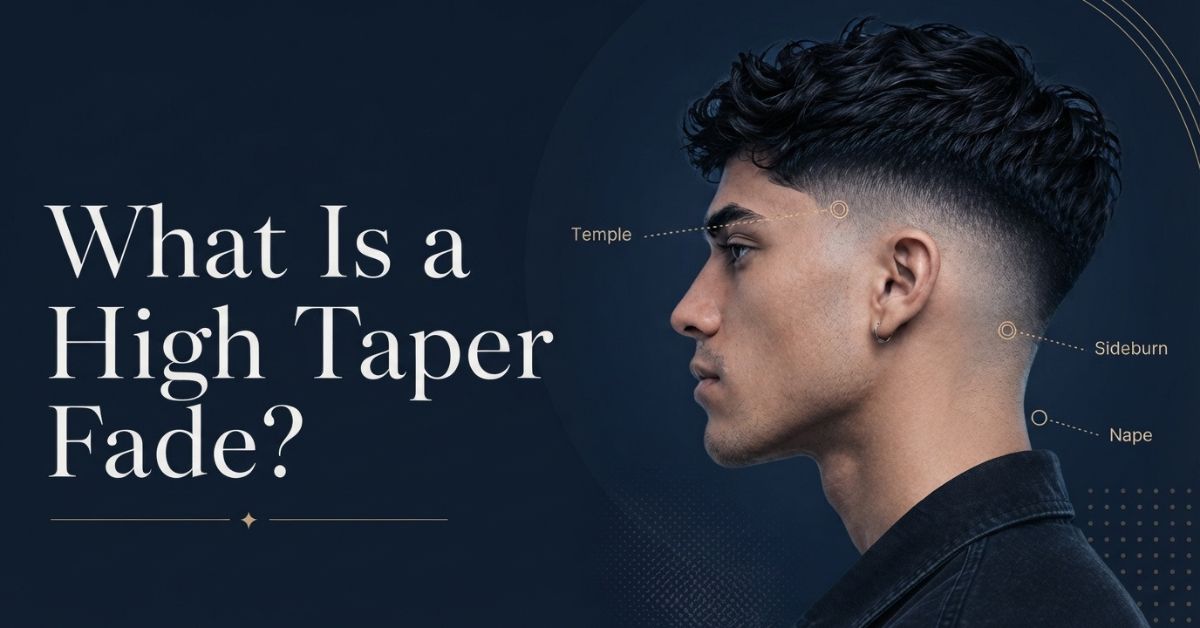
A high taper fade is a haircut where the transition from longer hair to shorter hair is positioned relatively high, usually around the temples and upper sideburn area, with tapering also used around the neckline.
The result combines three visual elements:
- A higher transition point.
- A gradual blend from longer to shorter hair.
- A longer top and selected side areas that preserve the haircut’s overall shape.
Unlike a full high fade, the goal is not necessarily to remove most of the hair from the entire side and back. The exact amount of retained weight depends on the barber and the requested design.
Cut anatomy: fade zone, blend, and retained length
Think of the haircut as three connected zones.
Fade zone: This is where the hair becomes noticeably shorter. With a high taper, it sits higher around the temple and can also be prominent at the nape.
Blend: This is the gradual transition between longer and shorter hair. A good blend should not leave an obvious horizontal shelf or harsh step.
Retained length: This is the hair deliberately left above or around the blend. Retained weight is what separates many high taper designs from a more aggressive high fade.
The shortest point can be a shadow, a close clipper length, zero, or skin depending on the barber’s terminology and your preference. Always specify it.
Terminology: why the name varies between barbers
There is no universal haircut dictionary that every barber follows.
Some barbers use “taper” to mean the shortest area stays above skin. Others use “taper fade” more broadly and may take selected areas extremely close. Some guides even define high taper and high fade primarily by how much side hair remains.
So instead of saying only:
“Give me a high taper fade.”
say:
“Start the taper high around my temples, keep more weight on the upper sides, take the shortest point to a shadow, and keep the neckline natural.”
That gives your barber something measurable to work with.
High taper fade vs high fade, low taper, and mid taper

The easiest way to understand the difference is to focus on where the transition sits and how much hair is removed.
| Haircut | Main placement | Side weight | Overall effect |
|---|---|---|---|
| High taper fade | High around temples and nape | Moderate to high | Bold but controlled |
| High fade | High across much of the sides and back | Low | Very strong contrast |
| Mid taper | Around the middle of the sides | Moderate | Balanced and versatile |
| Low taper | Lower around ears and neckline | High | Subtle and conservative |
A high taper fade emphasizes the perimeter while allowing more structure to remain elsewhere.
A high fade usually removes more hair across the entire side and back. It therefore creates stronger scalp exposure and a more dramatic silhouette.
A mid taper gives you a compromise. It provides definition without pushing the transition as high.
A low taper is the safest choice if you want a cleaner outline without dramatically changing the side profile.
What are the main benefits of a high taper fade?
The biggest advantage is contrast. The shorter perimeter makes the hair on top look fuller, longer, or more defined.
Other benefits include:
- It works with many top styles.
- It can frame the face more sharply.
- It suits straight, wavy, curly, and coily textures.
- It can make thick sides feel lighter without removing everything.
- It pairs well with beards.
- It can look modern while still remaining relatively practical.
- It gives short hairstyles more visual structure.
The style is especially useful when you want the top to remain the star of the haircut while the sides and neckline look controlled.
Who does a high taper fade suit?
A high taper fade can suit many people, but the best version depends on your hair, head shape, hairline, and willingness to maintain the cut.
Hair texture, density, and growth pattern
Straight hair: A high taper works well with crops, quiffs, side parts, slick-backs, and short textured tops.
Wavy hair: The taper can remove visual bulk while allowing natural movement to remain on top.
Curly hair: A tight perimeter can make curls look more prominent by creating contrast around the top.
Coily hair: High tapers pair naturally with rounded shapes, defined coils, twists, locs, and other textured styles.
Density matters too. Thick hair can support a strong high taper without looking overly thin above the blend. Fine hair may benefit from a softer transition that does not expose too much scalp.
Growth pattern matters as well. Cowlicks, uneven temple growth, recession, and irregular nape growth can affect where the barber should place the transition.
Face, head shape, hairline, and scalp visibility
A high taper can visually add height because the sides become tighter while the top remains fuller.
However, it is not automatically perfect for every head shape.
If your face is already long, an extremely high taper combined with a tall quiff may exaggerate vertical length. A moderate top height can create better balance.
If your forehead is prominent or your hairline is receding, discuss the temple placement before cutting. Taking the taper too high can expose more of the hairline than you expected.
Scalp visibility is another consideration. A skin or very close finish can reveal scars, pigmentation, bumps, or areas of lower density.
Lifestyle and upkeep tolerance
A high taper is best for someone who likes a fresh, defined haircut.
If you want the blend to stay crisp, expect regular barber visits. Many current guides place maintenance around two to three weeks, although the exact timing depends on growth speed and how sharp you want the haircut to remain.
If you prefer longer gaps between appointments, choose a softer taper, darker blend, or slightly longer shortest length.
Which high taper fade style fits your hair?
The best high taper is not one specific haircut. It is a foundation that can be adapted to your texture and top length.
High taper fade styles for curly and coily hair
Curly and coily textures create strong contrast against short tapered sides.
The key is preserving enough length on top to show the natural curl pattern.
Rounded afro or defined curly top
A rounded afro gives the taper a strong frame. Keep the crown reasonably full and ask the barber to clean the perimeter without flattening the natural shape.
For defined curls, keep enough length for the curl pattern to form. Heavy thinning can reduce the fullness that makes this combination work.
Twists, locs, or braids with a high taper
A high taper can clean up the temples and nape while leaving the main protective or textured style intact.
Tell your barber whether the taper should connect visually with the beard and whether the neckline should remain natural.
High taper fade styles for straight and wavy hair
Straight and wavy hair gives you plenty of styling options.
Textured crop or forward fringe
A textured crop works particularly well when you want a short, low-effort top.
Ask for texture rather than excessive thinning. The goal is controlled separation, not removing so much density that the top looks weak.
A forward fringe can also soften a prominent forehead.
Side part, quiff, or pompadour
A side part creates a more traditional appearance. A quiff adds height and movement, while a pompadour creates a stronger vintage-inspired silhouette.
With these styles, tell the barber how much length you need on top before asking for the taper.
Short high taper fade options with less daily styling
You do not need a long top to wear a high taper.
Buzz cut or crew cut
A buzz cut creates a simple, masculine silhouette with minimal styling.
A crew cut leaves slightly more length on top and gives you greater control over shape.
Both are practical choices when you want the haircut to look presentable without spending much time in front of a mirror.
Short textured top
A short textured top gives you movement without requiring significant styling.
A small amount of matte product can emphasize texture, but many short cuts can also be worn naturally.
Beard and neckline pairings
The beard can determine whether your high taper looks connected or separated.
Temple-to-beard blend
A temple-to-beard blend connects the haircut to the facial hair. It creates a smoother transition and can make the entire side profile look intentional.
Tell your barber whether you want the beard blended gradually or kept visually separate.
Tapered nape versus defined neckline
A tapered nape gives a softer, more natural finish and usually grows out less abruptly.
A defined neckline creates a cleaner, more deliberate edge.
Choose the tapered option if you prefer a relaxed appearance. Choose a defined neckline if you want stronger visual structure.
How do you ask a barber for a high taper fade?
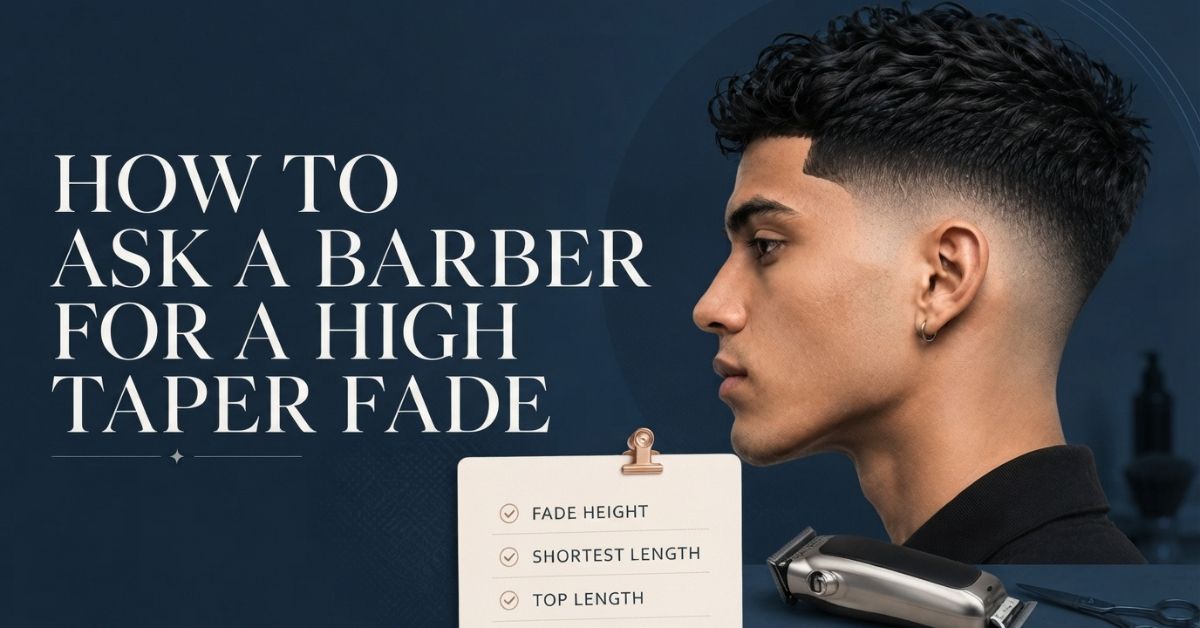
Do not rely on the haircut name alone.
The safest request covers the exact parts that change the finished result.
Seven haircut specifications to agree on
Before the cut begins, confirm these seven points:
- Height: Show exactly where you want the taper to start.
- Coverage: Explain whether the blend stays around the perimeter or travels farther across the sides.
- Shortest length: Choose shadow, guard length, zero, or skin.
- Top length: Give an approximate length or describe the finished style.
- Side weight: Say whether you want the upper sides full or reduced.
- Neckline: Choose natural, tapered, rounded, or defined.
- Temple and hairline: Explain whether you want a natural hairline or sharper edge.
These details remove much of the ambiguity surrounding the phrase “high taper fade.”
Reference-photo checklist
A good reference photo should show:
- The side profile.
- The back of the haircut.
- The temple area.
- The neckline.
- The approximate top length.
- Your preferred level of scalp visibility.
One front-facing photograph is rarely enough. The side and back can completely change how the haircut is interpreted.
Copyable barber script
Use this as a starting point:
“I want a high taper fade with the transition starting high around my temples. Keep more weight on the upper sides instead of turning it into a full high fade. Take the shortest area to a shadow finish, keep the top around two inches, and give it a natural textured shape. Keep the nape softly tapered and blend the sideburns into my beard.”
Change the top length, shortest finish, and beard instructions to match your preference.
Your pre-appointment checklist
Before sitting down, know:
- How short you want the shortest area.
- How much top length you want to keep.
- Whether you want a skin finish.
- Whether the side weight should remain.
- Whether you want a sharp or natural hairline.
- Whether the neckline should be tapered or defined.
- Whether the beard should connect to the taper.
If you are unsure, tell the barber what you do not want. For example, “I do not want a full high fade or exposed skin across my entire sides.”
How do you maintain and style a high taper fade?
A high taper looks best when the transition stays clean and the top keeps its intended shape.
Refresh schedule and grow-out
For a consistently sharp appearance, many people refresh the haircut every two to three weeks.
You can stretch the interval if you prefer a softer appearance.
Watch the haircut instead of following a rigid calendar. When the temple blend loses its shape or the neckline becomes noticeably untidy, it is usually time for a refresh.
Daily styling by hair texture
Straight hair: Try matte clay, styling cream, or texture powder depending on the desired finish.
Wavy hair: Use a lightweight cream or mousse to enhance movement without making the hair heavy.
Curly hair: Apply curl cream or a lightweight leave-in product to damp hair, then let the curls dry naturally or use a diffuser.
Coily hair: Focus on moisture, definition, and gentle handling. Avoid products that leave heavy buildup around the tapered areas.
The product should support the haircut rather than hide it.
Safe between-visit cleanup
You can carefully clean obvious stray hairs around the neckline or sideburns between appointments, but avoid aggressively recreating the fade yourself.
Do not push your hairline higher just to make it look temporarily sharper. A few misplaced clipper passes can change the haircut’s shape.
If you use personal grooming tools, clean them properly and avoid sharing unclean blades.
What are the drawbacks and safety considerations?
A high taper is versatile, but it is not maintenance-free.
Practical drawbacks and edge cases
The main disadvantages include:
- High placement can expose a receding temple.
- Very short finishes can reveal scalp irregularities.
- Fast growth can make the blend look uneven quickly.
- A poorly placed taper can make the face appear longer.
- Fine hair may look thinner when too much side weight is removed.
- Terminology differences can result in the wrong haircut.
- A dramatic taper may not suit conservative workplace requirements.
The solution is usually better communication rather than avoiding the haircut entirely.
Irritation, razor bumps, and barber-tool hygiene
Very close cutting can irritate sensitive skin. Some people are also prone to razor bumps or ingrown hairs, particularly around the neck and hairline.
If your skin reacts easily, tell your barber before the cut. You may prefer a shadow or guard finish instead of a skin-close finish.
Good hygiene matters too. Clippers, trimmers, combs, and other reusable tools should be properly cleaned and disinfected according to professional barbering practices.
If you notice persistent swelling, severe irritation, pus, or worsening pain after a haircut, seek appropriate medical advice rather than repeatedly shaving the area.
What are the best alternatives to a high taper fade?
A high taper is not your only option.
Choose a low taper if you want subtle cleanup around the ears and neckline.
Choose a mid taper if you want a balanced transition between subtle and dramatic.
Choose a high fade if you want much more hair removed from the sides and stronger scalp exposure.
Choose a burst fade if you want the short area concentrated around the ear while preserving a different shape through the back.
Choose a drop fade if you want the fade to follow the natural curve of the head toward the back.
Your choice should depend on the amount of contrast, side weight, scalp exposure, and maintenance you actually want.
High taper fade FAQs
Is a high taper fade the same as a high fade?
No. A high taper usually concentrates the transition around the perimeter, while a high fade removes more hair across the sides and back.
Is a high taper fade good for curly hair?
Yes. The short perimeter can create strong contrast with curls or coils left longer on top.
How often should I get a high taper fade?
A refresh every two to three weeks is common for a consistently sharp appearance, but faster or slower growth can change that schedule.
Does a high taper fade reach the skin?
It can, depending on the barber and the requested finish. Specify whether you want shadow, a guard length, zero, or skin.
What face shape is best for a high taper fade?
It can work with many face shapes. Adjust the top height and taper placement so the finished proportions balance your face.
Can a high taper fade work with a beard?
Yes. A temple-to-beard blend can create a seamless connection between the haircut and facial hair.
Is a high taper fade professional?
Yes. Keep the transition controlled, avoid excessive contrast, and choose a neat top and neckline for a more conservative result.
Is a high taper fade low maintenance?
The styling can be low maintenance, especially with a short top, but keeping the taper sharp requires regular trims.
What should I show my barber?
Bring side and back reference photos that clearly show the taper height, shortest finish, top length, and neckline.
Is a high taper fade good for thin hair?
It can be, but taking the sides too short may increase scalp contrast. A softer finish and controlled side weight can create a fuller appearance.
Bringing it together
The high taper fade haircut is best understood as a combination of placement, blending, retained weight, and top styling rather than a single fixed haircut.
The word “high” tells your barber where the transition should sit. It does not automatically tell them how short the fade should be, how much side weight to remove, or what neckline you want.
For the best result, discuss the seven key details before the cut: taper height, coverage, shortest length, top length, side weight, neckline, and hairline.
Then show side and back references.
That small amount of preparation can make the difference between getting the high taper you imagined and accidentally getting a completely different fade.

