

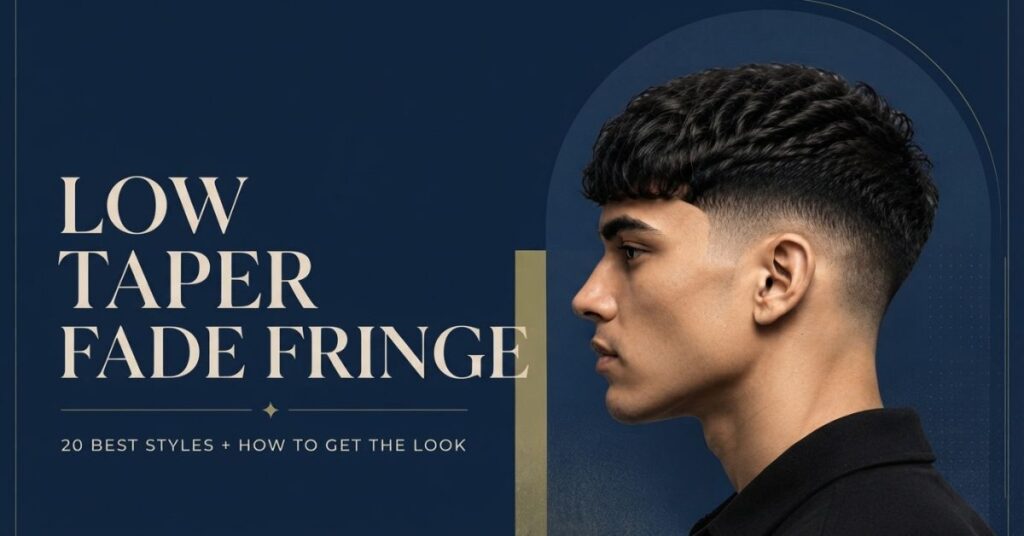
A low taper fade fringe keeps the sides clean and the front soft. It is one of the easiest haircuts to wear to work, the gym, or a night out. This guide explains what the cut is, who it suits, and how to ask for it. You also get 20 style ideas, styling steps, product picks, upkeep tips, and typical costs.
What is a low taper fade fringe?

A low taper fade fringe is a men’s haircut with short, gently faded sides and a longer fringe on top. The taper starts low, around the sideburns, ears, and neckline. The fringe falls forward over the forehead.
Quick definition: it is a low taper fade on the sides and back, paired with 2 to 4 inches (5 to 10 cm) of length at the front.
Two terms matter here:
- Taper: hair gets gradually shorter toward the hairline. Most of the length stays on the head.
- Fade: hair blends down to a very short length or skin. A low fade sits just above the ears.
A low taper fade is the subtle version. It never climbs to the temples, so it looks neat without looking harsh. That is why barbers often recommend it to first-time fade clients.
What it looks like from the front, side, and back

Front: the fringe sits across or just above the brows. Texture breaks up the edge so it looks natural, not like a bowl.
Side: the hair shortens in a smooth curve around the ear. The fade should end cleanly at the sideburn.
Back: the nape is tapered into a neat, rounded or squared shape. Hair at the crown stays long enough to blend into the top.
Image alt text idea: “Front, side, and back view of a low taper fade fringe on a man with dark brown hair.”
How it compares to similar cuts
| Haircut | Fade height | Top length | Best for |
|---|---|---|---|
| Low taper fade fringe | Low, near ears and neck | Medium, falls forward | Everyday, office friendly |
| Mid taper fade fringe | Mid, around temples | Medium | A sharper contrast |
| High taper fade fringe | High, above temples | Medium | Bold, modern looks |
| Textured crop | Any | Short, 1 to 2 inches | Minimal styling |
| French crop | Any | Short, blunt, forward | Thinning front hairline |
| Low skin fade | Low, down to skin | Any | Very sharp edges |
The main difference between a taper and a skin fade is how short the hair gets. A taper usually stops at a short guard length. A skin fade goes to bare skin. Tapers grow out more gracefully, so you can wait longer between visits.
Who does it suit?
This cut works for most men, but it shines in these cases:
- Men who want a clean look without a high maintenance routine
- Office workers who need a polished, professional style
- Straight, wavy, and curly hair types
- Students and young professionals trying a fade for the first time
- Men with a receding front hairline, if the fringe is kept short and textured
It is less ideal if you hate styling products or dislike hair touching your forehead. In that case, a short crop may suit you better.
Best fringe for your face shape

Face shape changes which fringe looks best. Use this as a starting point, then adjust with your barber.
- Oval: almost any fringe works. Try a textured or side swept style.
- Round: add height at the roots. Avoid heavy, blunt fringes that widen the face.
- Square: soften strong angles with a side swept or relaxed fringe.
- Oblong: choose a fuller fringe that sits lower on the forehead to shorten the face.
- Heart: a longer, side swept fringe balances a wider forehead and narrow chin.
- Diamond: a textured, forward fringe softens prominent cheekbones.
20 best low taper fade fringe styles
Use these ideas as a menu. Each one lists what to tell your barber. Add a reference photo for the best result.
1. Short textured fringe
A clean, short fringe with choppy ends. It is the safest starting point. Ask for: point cutting on the fringe and a low taper.
2. Side swept fringe
The fringe moves to one side for a classic, smart finish. Ask for: a side part with a soft taper.
3. Messy fringe
Tousled and relaxed. It suits wavy hair and casual wardrobes. Ask for: deep layers and a razor finish.
4. Blunt fringe
A straight line across the forehead. It suits thick, straight hair. Ask for: a clean cut line and light thinning.
5. Curtain fringe
The hair parts in the middle and frames the face. It is popular in Korean inspired looks. Ask for: a center part and longer front layers.
6. Textured crop
Short on top with a defined, broken edge. It needs almost no styling. Ask for: a 1 to 2 inch crop with a low taper.
7. French crop
Short and blunt, brushed straight forward. It hides a receding hairline well. Ask for: a short fringe with a low fade.
8. Brush forward fringe
Hair is combed toward the forehead with slight texture. Ask for: a longer front and shorter crown.
9. Angled fringe
The fringe is cut on a diagonal for a sharper shape. Ask for: an angled front line.
10. Two block fringe
Sides are cut short and top is kept longer with a clear separation. Ask for: a two block cut with a low taper.
11. Disconnected fringe
A noticeable gap between the top and the fade. It is a bolder look. Ask for: a hard disconnect at the transition.
12. Fringe with curls
Curly hair falls forward in defined ringlets. Ask for: a curl friendly cut on top with a low taper.
13. Wavy fringe
Natural waves create movement and body. Ask for: scissor cut layers without over thinning.
14. Thin hair fringe
Shorter layers add the look of thickness. Ask for: a light texture and minimal razor work.
15. Blowout fringe
Lifted at the front with a voluminous finish. Ask for: layers at the front and a blow dry.
16. Spiky fringe
Small, defined spikes for a youthful edge. Ask for: short layers on top with a low taper.
17. Long fringe
Sits near the eyes. It needs regular trims. Ask for: extra length at the front and subtle layers.
18. Fringe with burst fade
The taper curves around the ear for extra shape. Ask for: a low burst taper with a textured fringe.
19. Bleached or blonde fringe
A colored top adds contrast to dark sides. Ask for: a color consultation first, then the cut.
20. Slicked fringe
Hair is combed down and set with light product. It works for formal events. Ask for: a longer fringe and a clean taper.
Image alt text tip: describe each photo with the style name, hair type, and fade height, for example “textured fringe with low taper fade on straight black hair.”
How long should your hair be?
Length depends on your hair type and the style you want.
| Area | Typical length |
|---|---|
| Fringe at the front | 2 to 4 inches (5 to 10 cm) |
| Crown and top | 2 to 3 inches (5 to 7.5 cm) |
| Sides at the taper | #0.5 to #2 guard at the base, blending up |
| Neckline | Tapered short and clean |
Here are a few simple rules:
- Straight hair can go a little shorter. It hangs flat and shows length quickly.
- Wavy and curly hair needs extra length because it springs up when dry.
- Fine hair looks fuller with shorter, layered lengths.
- Thick hair can handle longer fringes if the barber thins them lightly.
If you are growing out your hair, tell the barber. They can keep the front long while the sides stay neat.
In the barber’s chair: what to ask for and what to expect
Be specific. Vague words like “short” or “medium” mean different things to different people.
A simple script:
“I would like a low taper fade on the sides and back. Start just above the ear and blend down to the neckline. Leave about three inches on top, with a textured fringe that falls over my forehead.”
What happens during the cut:
- The barber sections the hair and cuts the fringe first.
- The top is layered or point cut for texture.
- Clippers create the taper, starting low and working up.
- A trimmer cleans the neckline and around the ears.
- The barber checks the fringe dry and makes small fixes.
Tips for a better result:
- Bring two or three photos from different angles.
- Mention your usual part and cowlick.
- Tell the barber how much time you spend styling.
- Ask how to recreate the look at home.
How to style it at home
You need about five minutes.
- Wash and towel dry. Leave the hair slightly damp.
- Apply a pre styler. Sea salt spray or mousse adds lift at the roots.
- Blow dry. Use medium heat. Direct the fringe forward, then to the side if you want a part.
- Warm the product. Rub a pea sized amount between your palms.
- Work it through. Use your fingers to shape the fringe and top.
- Finish. Add a light mist of hairspray for hold.
Style tip: use a comb for a neat look. Use your fingers for a messy look.
Best products
Pick products by finish and hair type.
- Matte clay or paste: best for texture and a natural look. Good for thick and medium hair.
- Sea salt spray: adds grip and body. Good for fine and straight hair.
- Pomade (water based): adds shine and a controlled shape. Good for slicked styles.
- Mousse: adds light volume. Good for wavy and curly hair.
- Curl cream: defines curls and reduces frizz.
- Light hairspray: locks in shape without stiffness.
Avoid heavy waxes on fine hair. They weigh it down and make the fringe look greasy.
Maintenance and upkeep
The low taper fade is forgiving, but it still needs regular care.
- Fade and neckline: trim every 3 to 4 weeks.
- Fringe: trim every 6 to 8 weeks, or when it touches your lashes.
- Shampoo: wash 2 to 3 times a week. Over washing dries out the scalp.
- Conditioner: use a light one on the fringe.
- Scalp care: exfoliate gently once a week if you use styling products often.
- Sleep: a silk or satin pillowcase can reduce frizz and bedhead.
Because the taper is low, the grow out looks tidy for longer than a high fade does.
Common mistakes to avoid
- Choosing the wrong fade height. A fade that starts too high can look harsh with a soft fringe.
- Skipping the reference photo. Words alone leave room for mistakes.
- Over thinning the fringe. Too much razor work leaves it flat and see through.
- Using too much product. It makes the hair stiff and shiny.
- Ignoring your cowlick. A cowlick at the front can push the fringe the wrong way. Tell your barber early.
- Waiting too long between trims. The taper loses its shape in about 4 weeks.
- Fighting your natural hair pattern. Work with your waves or curls, not against them.
Pros and cons
What works
- Looks neat and modern with little effort
- Suits most hair types and face shapes
- Grows out gracefully
- Easy to style in minutes
- Works for school, office, and weekend wear
- Adaptable: swap from textured to slicked with a different product
What to consider
- Needs a trim every 3 to 4 weeks to keep the fade sharp
- The fringe can fall into your eyes if cut too long
- A weak barber may blend the taper unevenly
- Very fine or thinning hair needs a careful cut
- Humidity can make the fringe frizz or collapse
How much does it cost?
Prices vary by city, barber skill, and salon type. These are typical ranges in the United States. Expect different numbers in other countries.
| Type of shop | Typical price |
|---|---|
| Neighborhood barbershop | $25 to $40 |
| Mid range barbershop | $35 to $55 |
| Premium or salon | $60 to $90 or more |
A fringe with color, a blow dry, or a long consultation costs more. Tipping 15 to 20 percent is common in the United States. Add the cost of styling products, which usually run $10 to $25 each.
Frequently asked questions
What is a low taper fade fringe?
It is a haircut with short, gradually faded sides that start low near the ears and neck, and a longer fringe on top.
How often should I get a trim?
Trim the fade every 3 to 4 weeks and the fringe every 6 to 8 weeks.
Is a low taper the same as a low fade?
Not exactly. A taper keeps more length and blends softly. A fade goes shorter, sometimes to skin.
Does it work on curly or wavy hair?
Yes. Ask for a curl friendly cut on top and a low taper on the sides.
Can thin hair pull it off?
Yes. A shorter, lightly layered fringe makes fine hair look fuller.
What should I tell my barber?
Say “low taper fade, textured fringe, about three inches on top,” and bring a photo.
What products should I use?
Use matte clay or paste for texture, sea salt spray for lift, and light hairspray for hold.
Is it professional enough for work?
Yes. The low taper keeps the sides neat, so it works in most offices.

