

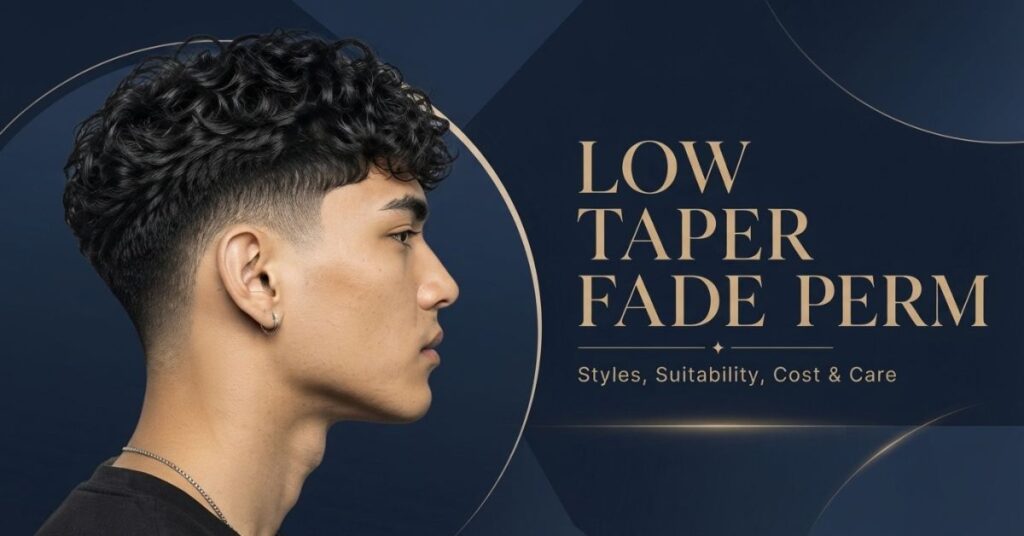
A low taper fade perm combines chemically created waves or curls on top with a low taper around the temples, sideburns, and neckline. The perm creates the texture, while the taper keeps the edges clean without removing too much hair from the sides.
The result can be soft and natural with loose waves, or bold and defined with tighter curls. The right version depends on your hair length, condition, density, desired curl pattern, and how much styling you want to do every day.
This guide explains what a low taper fade perm is, which styles are popular, how the salon process works, what it costs, how long it lasts, and how to protect your hair afterward.
What is a low taper fade perm?

A low taper fade perm is a hairstyle that combines two separate services. A perm chemically changes the texture of the longer hair, while a low taper gradually shortens the hair around the lower temples, sideburns, and neckline.
Unlike a broad low fade, a low taper usually keeps more weight around the sides. That extra fullness can make the transition into curly or wavy hair look more natural.
The final appearance depends on the rod size, starting length, curl pattern, taper placement, and amount of hair left above the ears. Because barbers and salons can use the words “taper” and “fade” differently, showing several reference photos is often more useful than naming the style alone.
What does the low taper change?
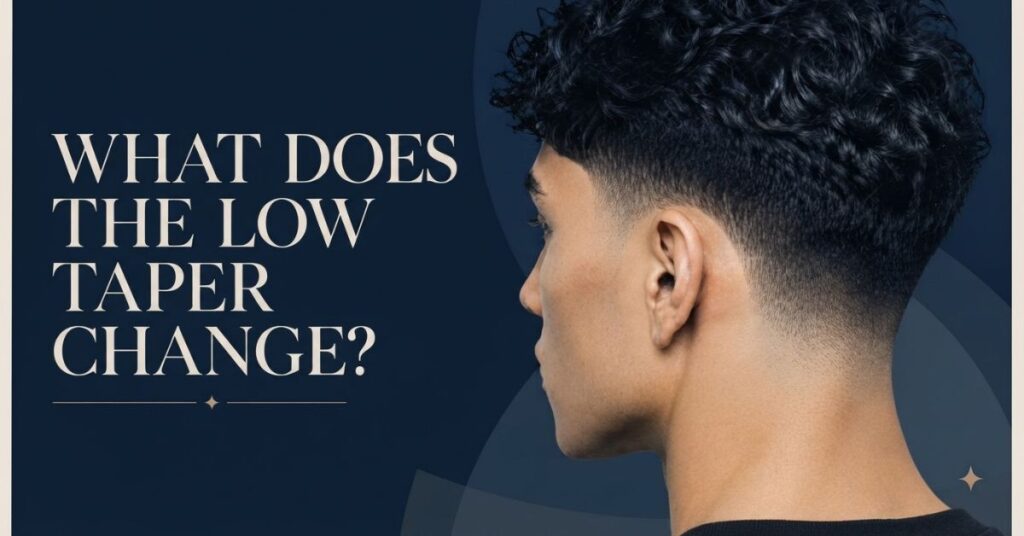
The low taper changes the outline and proportions of the haircut rather than creating the curls.
The shortest area stays relatively low around the temples, sideburns, and neckline. Hair above that area remains fuller, helping the permed top blend into the sides instead of appearing disconnected.
A low taper can also make a curly top look more controlled without removing as much side volume as a traditional fade. The exact starting point should be discussed with your barber because the visual result changes significantly when the taper is taken higher.
What does the perm change, and how does it work?
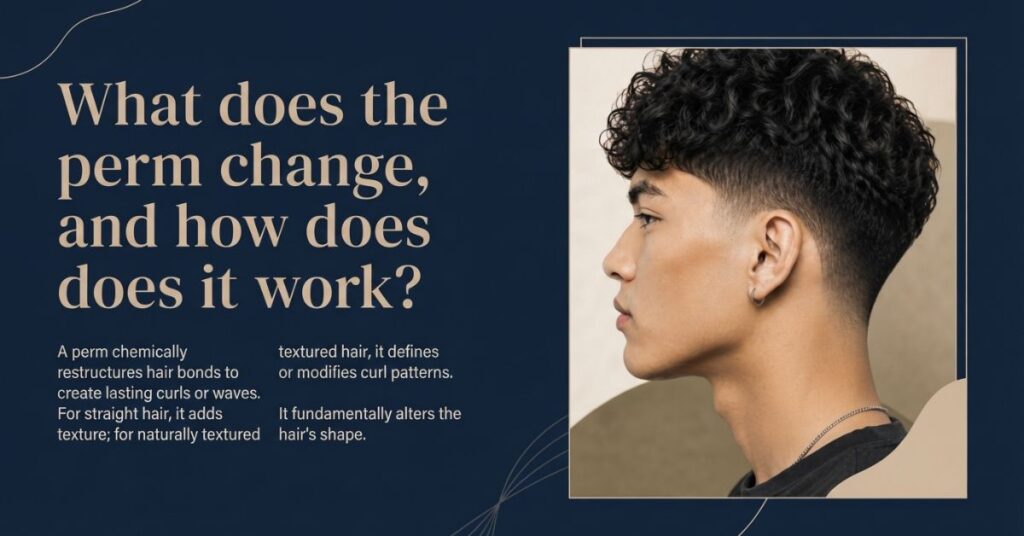
A perm changes the hair’s internal structure so straight or lightly wavy hair can hold a new wave or curl pattern. During a traditional perm, sections are wrapped around rods, treated with a chemical solution, rinsed, and then neutralized to set the new shape.
Rod size is one of the biggest factors controlling the result. Larger rods generally create softer waves, while smaller rods create tighter curls and more shrinkage.
The process is chemical, so hair condition matters. Professional haircare guidance notes that perming can leave hair dry or brittle, particularly when the hair has already been heavily processed.
Is a low taper fade perm right for your hair?
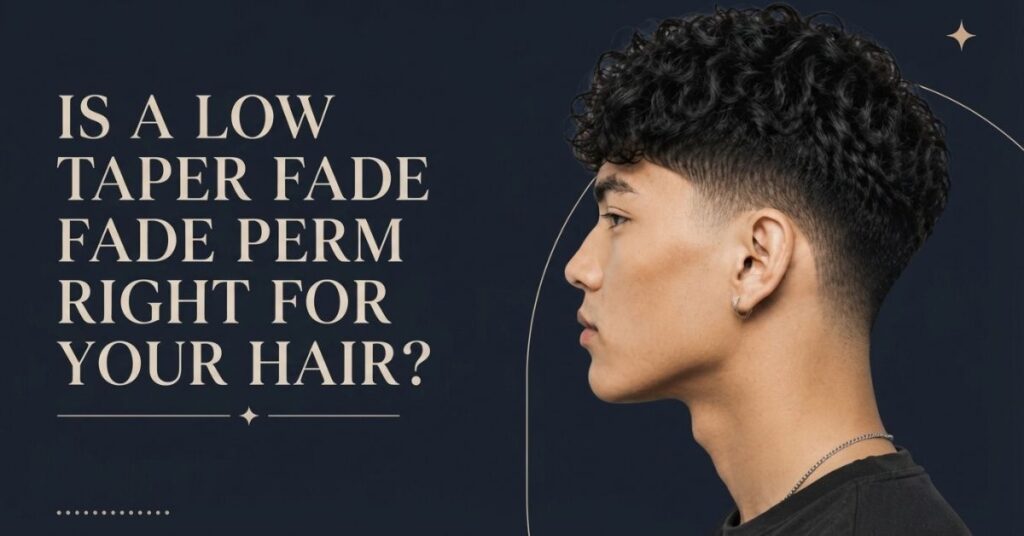
A low taper fade perm can work on straight, wavy, fine, thick, or dense hair, but the same formula will not produce the same result on every head.
Your stylist should consider your hair’s length, density, elasticity, previous chemical treatments, and desired curl size before choosing the technique.
How much length and what condition are required?
There is no universal minimum length because the required length depends on the curl you want. A tighter curl can visually occupy less space after shrinkage, while a loose wave needs enough length to wrap around a larger rod and still show movement.
As a practical starting point, many men’s perm styles need several centimeters of usable length on top. Your stylist should determine the exact length based on the rod size and finished shape rather than relying on one fixed measurement.
Hair condition is even more important. Tell your stylist about:
- Recent bleach or highlights
- Permanent color
- Previous perms
- Chemical straightening
- Excessive heat styling
- Breakage or split ends
- Scalp irritation
If the hair is already fragile, processing it again can increase the risk of dryness and breakage.
Which curl pattern will suit the shape?
Choose the finished silhouette first, then select the curl pattern.
Loose waves create movement and a relaxed appearance. They work well when you want texture without making the perm look extremely obvious.
Medium curls provide more volume and definition while still allowing the hair to move naturally.
Tight or spiral curls create the strongest texture and usually produce more visible shrinkage. They can make the taper appear sharper because of the contrast between the textured top and shorter sides.
Your fringe direction also matters. Forward curls create a textured crop effect, while a middle part or side sweep creates a softer, more directional shape.
When should you postpone or skip the perm?
Consider postponing the service if your hair is severely dry, breaking, heavily bleached, or recently exposed to another strong chemical treatment.
An irritated scalp is another reason to wait for professional assessment. If you experience excessive stinging or burning while the perm solution is being applied, the American Academy of Dermatology advises washing the solution off immediately and consulting a dermatologist.
Do not hide your chemical history to get the appointment. A stylist needs accurate information to decide whether the hair can safely handle another chemical process.
Which low taper fade perm style should you choose?
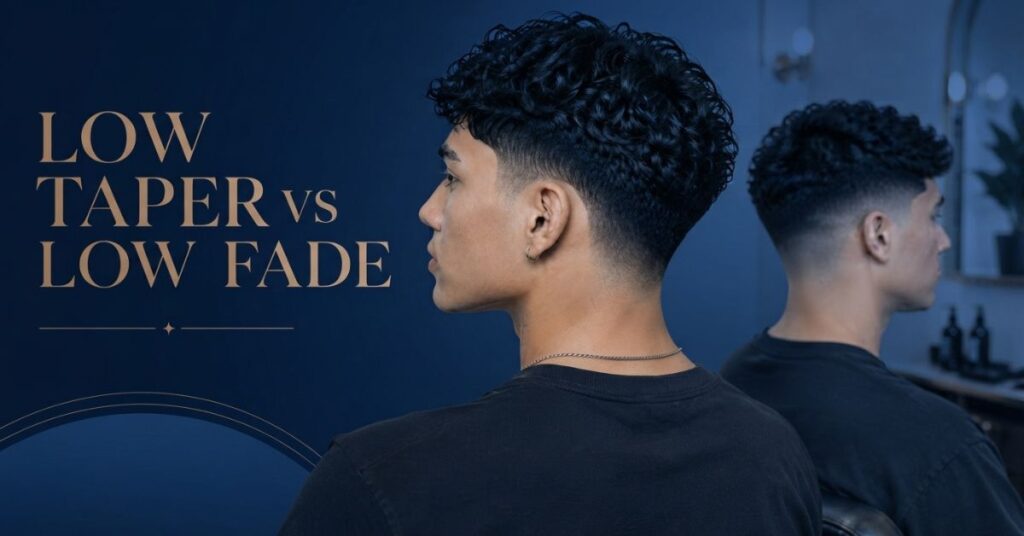
The best version depends on how much curl, volume, and contrast you want. Four popular directions cover most requests.
Loose-wave perm with a low taper
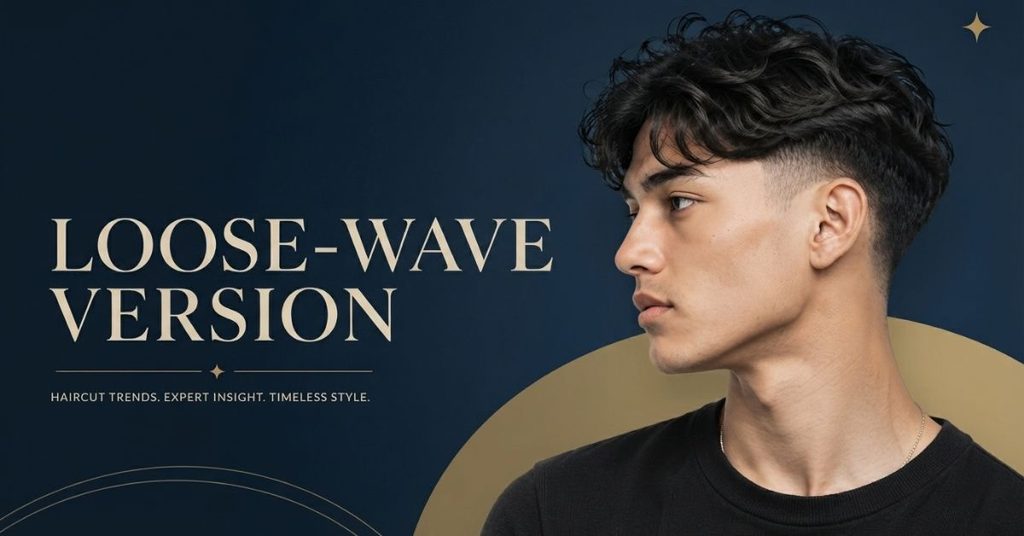
A loose-wave perm creates broad bends instead of tight ringlets. It gives straight hair movement while preserving a relatively natural appearance.
Pairing it with a subtle low taper keeps the sides neat without making the top look disconnected. This option is useful if you want texture but do not want a very curly finish.
Ask for larger rods, a soft wave, and a low taper that keeps some weight above the ears.
Tight or spiral curls
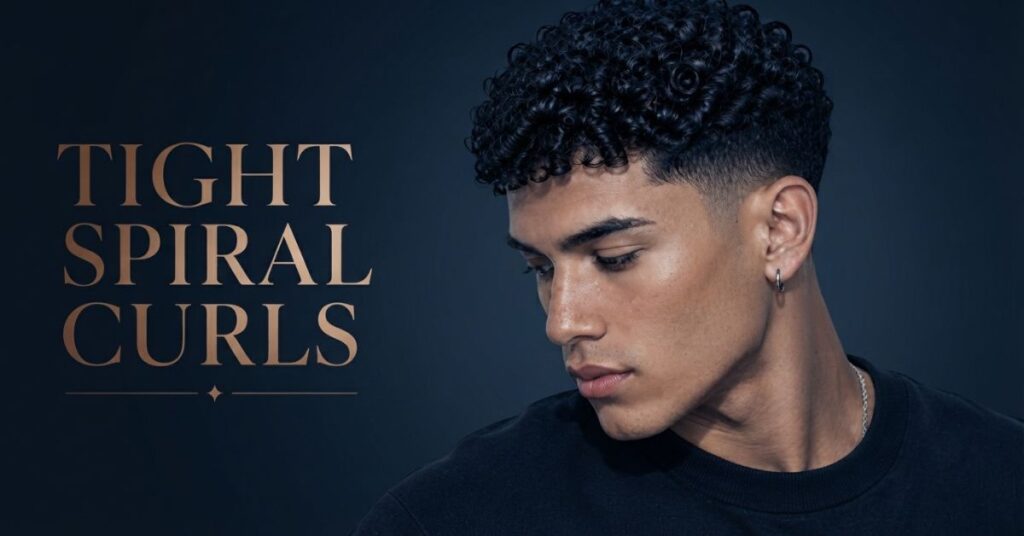
Tight or spiral curls create stronger definition and more visible volume. Smaller rods produce a tighter pattern, but the finished hair will also shrink more.
This style can create a strong contrast with a clean low taper. It is especially useful if your main goal is to make curls the focus of the haircut.
Remember that the starting length should account for shrinkage. Hair that looks long enough before the service can appear substantially shorter once the curl is formed.
Korean-style soft perm
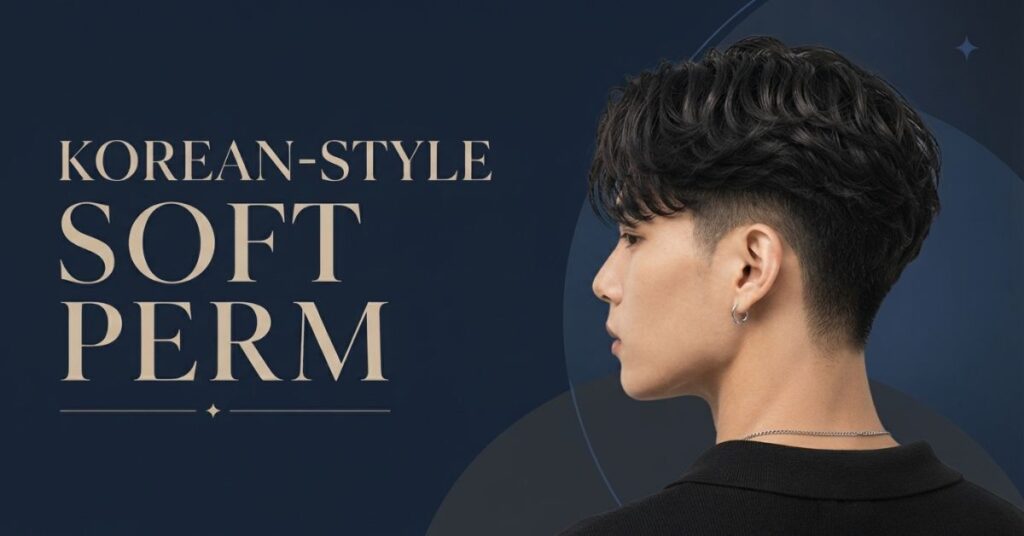
A Korean-style men’s perm generally focuses on soft movement, natural texture, and controlled volume rather than extremely tight curls. The terminology is broad rather than a single standardized technique.
It is often paired with a middle part, side-swept fringe, or soft forward movement. Some salons also offer a down perm, but that is a different service. A down perm is designed to flatten or relax resistant side hair rather than create curls on top.
Current salon menus show how these services can be priced separately. For example, ONIS in Los Angeles currently lists men’s perms at $120 to $180 and down perms at $50 to $100.
The textured-fringe or “broccoli” look
The textured fringe version keeps the permed top forward, creating a rounded, messy, high-volume appearance.
The nickname “broccoli” is informal, so it is better to explain the actual shape to your barber. Tell them whether you want the curls falling forward, how much forehead coverage you want, and how much volume should remain at the crown.
A low taper underneath helps prevent the forward curls from making the entire haircut look excessively wide.
How is a low taper fade perm created at the salon?
A professional appointment normally begins with consultation and hair assessment. The stylist then chooses the appropriate rod size and chemical system before processing the hair.
The taper and final shape are refined according to the stylist’s preferred workflow.
What should happen during the consultation?
Discuss four things before any chemical product is applied:
- Curl size: loose wave, medium curl, or tight spiral.
- Taper placement: how low the taper should sit around the temples and neckline.
- Top length: how much length should remain after accounting for shrinkage.
- Chemical history: color, bleach, previous perm, or straightening.
Bring front, side, and back reference photos. One photo can hide important details about the neckline and side profile.
What is the usual service sequence?
The exact order differs between professionals, but a typical appointment may include:
- Hair and scalp assessment
- Consultation and curl planning
- Hair preparation and sectioning
- Rod selection and wrapping
- Perm solution application
- Processing and monitoring
- Rinsing
- Neutralizing
- Haircut and taper refinement
- Styling and aftercare instructions
Do not assume a specific processing time from another person’s appointment. Chemical formulas, hair condition, and curl goals can change the timing.
What exactly should you ask for?
A clear request is more useful than simply saying “I want a low taper perm.”
Try:
“I want a low taper around the temples and neckline, with some weight left above the ears. Keep the top long enough for a loose, natural wave and let the fringe fall slightly forward.”
If you want tighter curls, replace “loose, natural wave” with “defined spiral curls.”
Also ask whether the haircut is included, how much the complete service costs, how long the appointment will take, and what aftercare the stylist recommends.
How much time, money, and commitment does it require?
A low taper fade perm is not just a haircut. It combines a chemical texture service with a haircut that needs regular cleanup.
Pricing varies considerably by city, salon, stylist experience, hair length, curl complexity, and whether the haircut is included.
How long should you allow for the appointment?
Plan for a substantial appointment rather than a normal haircut. Current salon listings show men’s perm appointments around one hour at some locations, while combined haircut and perm services can take roughly two to three hours or more.
Longer hair, dense hair, complicated rod placement, and custom styling can increase the time.
Ask for the estimated appointment duration when booking, especially if you are getting a perm for the first time.
What affects the price?
The main pricing factors are:
- Hair length and density
- Curl type and rod size
- Chemical history
- Stylist experience
- Salon location
- Whether a haircut is included
- Whether you need a specialty perm
- Additional treatments
Current Los Angeles salon menus illustrate the wide range. ONIS lists men’s perms at $120 to $180, Kim Sun Young lists men’s regular perms from $110, and Etude DTLA lists men’s regular perms from $180. These are local examples, not a universal market average.
Always confirm the final price before the service because some salons adjust pricing after seeing hair length and condition.
How long does it last and how does it grow out?
A perm does not simply disappear after a few washes. The treated hair gradually loses definition while new growth comes in with your natural texture.
Many men’s perm guides place the useful life of the texture around several months, but the exact timeline depends on hair type, curl strength, washing habits, and the service itself.
The taper has a much shorter maintenance cycle. Hair around the temples and neckline can look grown out within a few weeks, even while the permed top still has plenty of texture.
That means you usually maintain the taper and perm separately.
How do you maintain a low taper fade perm?
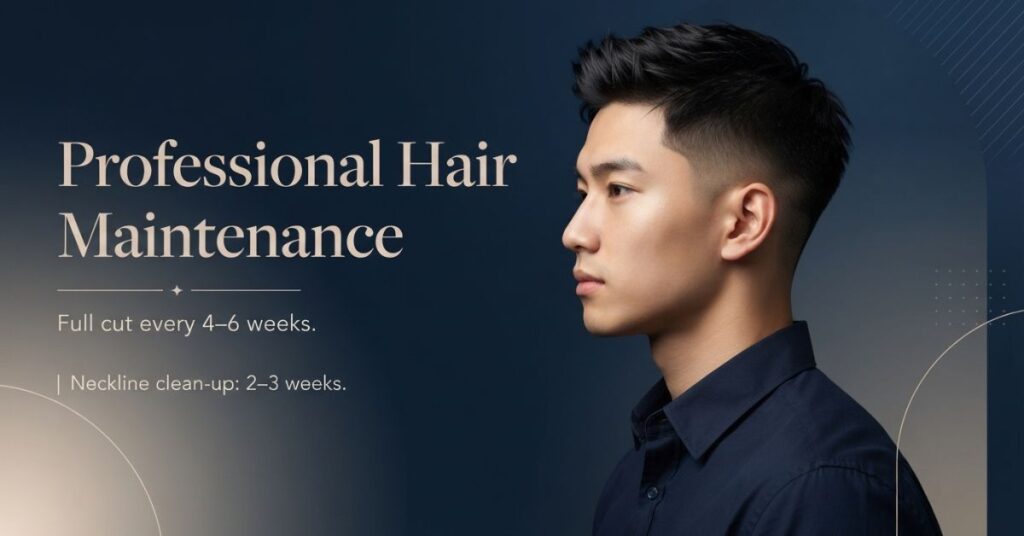
The simplest approach is to treat the top like textured hair while maintaining the taper on its own schedule.
Avoid rough handling, excessive heat, and unnecessary chemical processing.
What should you do during the first 48 hours?
Follow your stylist’s specific instructions. Professional Wella guidance recommends waiting at least 48 hours before washing or brushing a newly permed style and avoiding very humid conditions or sweaty workouts during that period.
During this initial period:
- Avoid washing the hair
- Avoid aggressive brushing
- Avoid pressing the curls flat with tight headwear
- Avoid unnecessary sweating
- Let the new texture settle naturally
If your stylist gives you a different product-specific instruction, follow that professional guidance.
How should you wash, dry, and style it?
After the initial setting period, treat the hair like wavy or curly hair.
A simple routine is:
- Use a gentle shampoo when cleansing.
- Apply conditioner to maintain softness.
- Detangle gently while the hair is damp.
- Apply a lightweight curl cream or mousse.
- Scrunch the hair instead of aggressively brushing it.
- Air dry or use a diffuser on low heat.
- Avoid excessive high-temperature styling.
A microfiber towel can also reduce rough handling compared with vigorous towel rubbing. The American Academy of Dermatology recommends gentle washing and conditioning practices for hair that is fragile or prone to damage.
When should you refresh the taper or perm?
The taper usually needs attention every few weeks, depending on how quickly your hair grows and how sharp you want the neckline and temples to look.
A full re-perm should not automatically happen every time you get a taper cleanup. Your stylist should assess the condition and amount of new growth before chemically processing the hair again.
Spacing chemical services can help reduce cumulative damage, particularly when the hair is already dry or processed.
What are the risks and common mistakes?
The biggest mistake is treating a perm like an ordinary haircut. A haircut removes or reshapes hair, while a perm chemically changes its structure.
How can chemical damage happen?
Perming can make hair drier and more brittle, particularly when the hair has already been bleached, colored, or chemically processed.
Common mistakes include:
- Perming heavily damaged hair
- Hiding previous chemical treatments
- Choosing a curl that requires excessive processing
- Using too much heat afterward
- Repeating chemical services too frequently
- Brushing curls aggressively
- Ignoring scalp discomfort
The American Academy of Dermatology specifically recommends caution with perming because chemical treatments can contribute to dry, brittle hair.
Which warning signs require action?
Excessive burning or stinging during processing requires immediate attention. The solution should be washed off and medical advice sought if necessary.
Afterward, severe scalp irritation, blistering, unusual breakage, or hair that becomes extremely weak should not be treated as normal styling problems. Contact the salon and consider speaking with a dermatologist.
What are the best alternatives if you don’t want a perm?
If you like the appearance but do not want chemical processing, try creating temporary texture.
Good alternatives include:
- Natural waves with a low taper
- Curl cream and a diffuser
- Lightweight mousse
- Heat-free rollers
- Temporary styling sets
- Layered textured cuts
- A curly or wavy low taper if you already have natural texture
These options require more frequent styling because the texture disappears or changes after washing, but they avoid permanently altering the hair with a chemical service.
What should you confirm before booking?
Before paying a deposit, confirm these details with the salon:
- Do they regularly perform men’s perms?
- Can they show examples of similar hair length and texture?
- What curl size will they create?
- Where exactly will the taper start?
- How much top length should you keep?
- Is the haircut included?
- What is the complete estimated price?
- How long will the appointment take?
- Have you discussed your previous chemical treatments?
- What aftercare does the stylist recommend?
If your hair is colored or bleached, ask whether a strand test or additional assessment is appropriate before processing.
Frequently asked questions
How long does a low taper fade perm last?
The texture commonly remains noticeable for several months, but the exact lifespan varies with hair type, curl strength, care routine, and new growth.
How long should hair be before getting a low taper fade perm?
There is no universal minimum because rod size and desired curl affect the required length. Your stylist should assess how much usable length is needed for your chosen result.
Can very straight hair get a low taper fade perm?
Yes. A perm can create waves or curls in naturally straight hair, provided the hair is long and healthy enough for the selected technique.
Can thick hair hold a perm?
Thick hair can be permed, but density and strand characteristics affect processing and rod selection. A professional should determine the appropriate technique during consultation.
Is a low taper fade the same as a low fade?
No. A low taper usually concentrates shortening around the temples, sideburns, and neckline, while a low fade generally removes or reduces more hair across the lower sides.
Can bleached hair get a low taper fade perm?
Sometimes, but heavily bleached or damaged hair may not be suitable for additional chemical processing. A stylist should assess its condition first.
Should you get the haircut or perm first?
There is no universal sequence because stylists use different workflows. Ask your stylist how they prefer to combine the haircut with the chemical service.
Can you wash your hair after a perm?
Most professional guidance recommends waiting at least 48 hours before washing or brushing, unless your stylist gives different product-specific instructions.
How often should you refresh a low taper?
Many people refresh the taper every few weeks because the temples and neckline show regrowth faster than the permed top loses its texture.
Is a low taper fade perm high maintenance?
It requires moderate maintenance because the curls need moisture and styling while the taper needs regular cleanup. The two parts of the hairstyle follow different schedules.
Final thoughts
A low taper fade perm works by combining controlled texture with a clean, low perimeter. The perm determines the movement and curl, while the taper controls the shape around the ears, temples, and neckline.
The most important decisions are not simply whether you want curls. You also need to choose the curl size, preserve enough top length, decide how much side weight you want, and make sure your hair is healthy enough for chemical processing.
For the best result, bring several reference photos, explain exactly where you want the taper, disclose your chemical history, and confirm the full price and aftercare before starting. If your hair is heavily damaged or your scalp is irritated, a consultation should come before the chemical service.

